After Four Years in Project-Based Work, Zhipu Reaches a Turning Point
Custom delivery can sustain you today. But only by turning core capabilities into standardized products, repeatedly callable assets, and infrastructure can revenue keep growing while you sleep.
On the last day of August, 智谱 (Zhipu, an AI model company) released its 2026 interim report.
The numbers were striking.
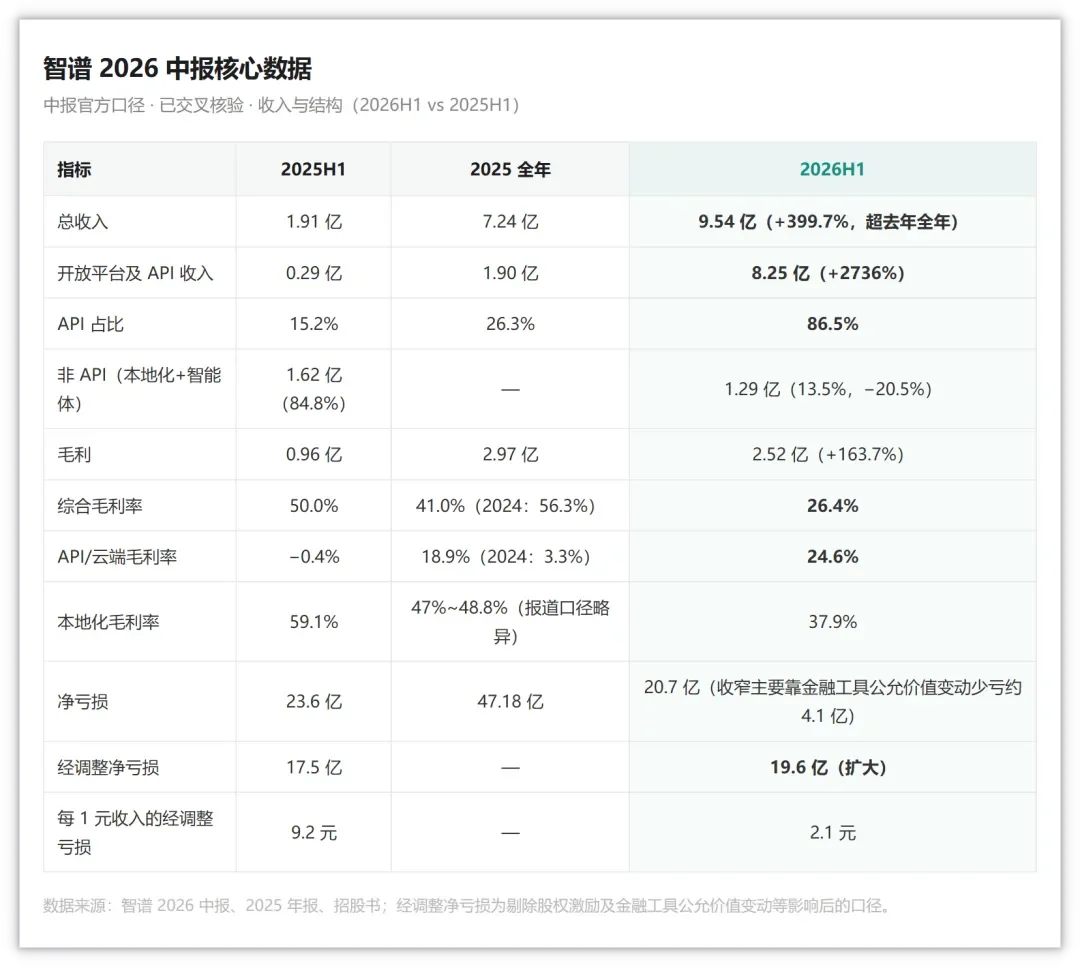
Total revenue in the first half reached RMB 954 million, up nearly 400% year on year, already exceeding the total for the whole of last year.
But among all those figures, what really surprised me were several clear structural indicators of a ‘turning point.’
At the earnings presentation, company secretary 肖磊 (Xiao Lei) said: ‘The change in revenue composition deserves more attention than the rate of revenue growth.’
That sentence is the most valuable summary of this interim report.
Look closely at the financial report, and you'll find three crucial changes taking place at Zhipu:
First, a complete reversal in revenue composition. Cloud API revenue reached RMB 825 million in the first half, soaring to 86.5% of total revenue. In the same period last year, that figure was just 15.2%; in 2022, only 4.5%.
Second, a turning point in API gross profitability. The gross margin of its cloud API business climbed from −0.4% in the same period last year to 24.6% this year. Alongside that, token inference cost fell 80% from the start of the year.
Third, an unusually steep growth curve. The earnings presentation revealed that, by the end of August, Zhipu's annualized run rate (ARR) had reached US$1.6 billion. By that calculation, revenue for August alone was around US$130 million, or more than RMB 900 million.
In other words, revenue for August alone almost matched the total for all six months of the first half.
That is a huge change in the numbers. To someone with industry experience, smooth linear growth in a product or business is nothing unusual. But when a growth curve suddenly turns upward and shoots skyward, it suggests a qualitative change may have occurred: an inflection point toward explosive exponential growth.
So I'll venture a prediction: Zhipu's turning point has arrived.
Four years immersed in project-based work: the real quagmire of B2B
Anyone in B2B knows: project-based work is a quagmire. It can keep you alive, but makes it hard to grow.
I first heard of Zhipu well before the large-model era—at least before 2022. I remember a company called 智谱华章 (Zhipu Huazhang), which seemed to be in big data.
At the time, it looked like a pure technology company: strong technology, but lacking application scenarios. It seemed to spend quite a long time expanding into vertical industries. I saw its recruitment ads for industry-specific solution experts more than once.
I also spent many years in B2B, from maintaining large equipment at a Fortune 500 multinational in my early career to working in SaaS later. I know very well what providing enterprise services feels like.
You sign a large customer, with a contract worth two or three million yuan, perhaps even more than ten million.
Once the deposit arrives, cash flow looks fantastic, and the team's living costs for the month are covered.
But what happens next?
You have to assign five to ten engineers to the site, stationed in the customer's server room or office.
Investigate the business, develop custom software, connect old systems, and deal with all kinds of unusual compatibility problems. You finally go live—and then come endless requirement changes and further custom development.
It's hard-earned money. Revenue is linear, and labor costs are linear too.
Zhipu's first four years followed much the same path.
Read the prospectus it submitted to the Hong Kong Stock Exchange, and you can see that four-year journey—
In the share of revenue from local deployment—that is, private, customized enterprise projects:
● 2022: 95.5% (annual revenue of RMB 57.41 million)
● 2023: 90.4%
● 2024: 84.5%
● 2025: 73.7%
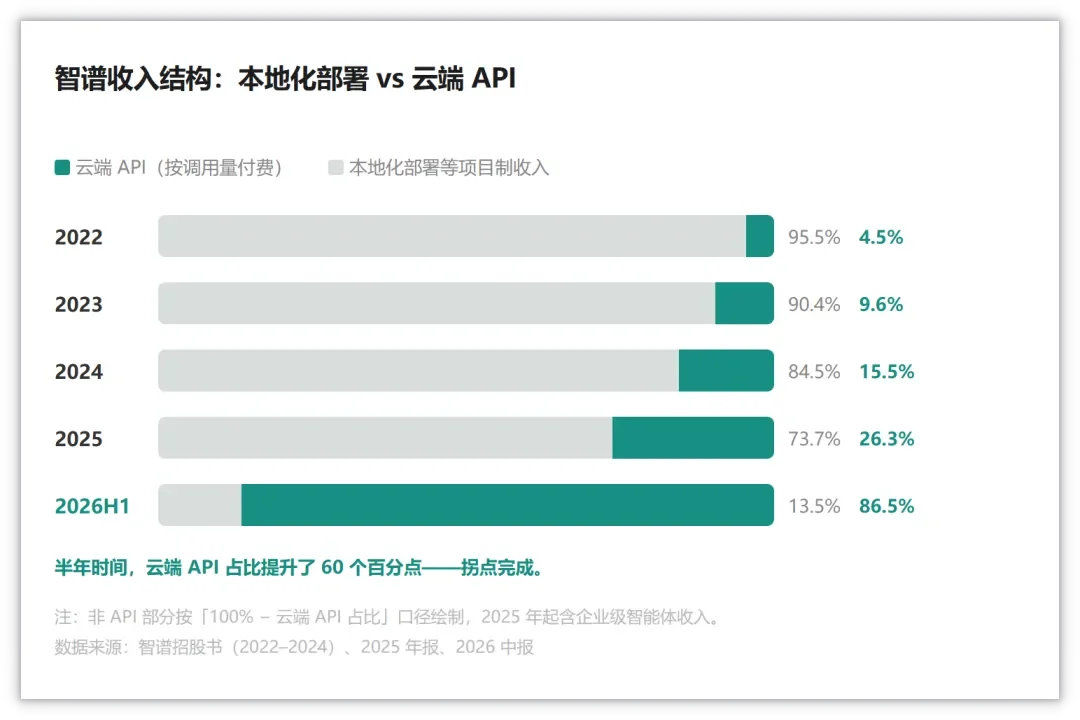
In four years, it moved just 22 percentage points.
In the first half of 2026, it shifted 60 points in one go.
A slow drift, then a sharp turn. That is a complete inflection point.
Even though Zhipu earned RMB 264 million from local deployment in 2024, that money came from 123 customers, averaging RMB 2.15 million per contract.
Its five largest customers accounted for 55.4% of revenue in 2022. If a major customer lets go, revenue caves in.
That is the cruelest ceiling of project-based work.
You can serve 100 large customers by pushing an elite team hard;
Serve 500, and management costs rise sharply;
What if you have to serve 1,000, or 10,000?
The delivery system is crushed in an instant.
Project-based companies also used to struggle to attract investors. Investors wouldn't give them high valuations for one reason: every yuan earned requires more working time.
Without compounding, you can never produce an exponential growth curve.
In their words: not sexy enough.
Why now, specifically?
Zhipu actually began building its MaaS (model-as-a-service) business in 2021.
Why, then, did API revenue remain at single-digit and low double-digit percentages for four whole years?
Because they didn't want to transform? Certainly not.
More likely: they wanted to, but couldn't. Before the foundation model's capabilities crossed a critical threshold, customers couldn't solve business problems with an API alone. They could only hire people to deliver a complete custom solution.
That is the only way to survive commercially when the technology is immature: intensive human delivery has to fill the gap in model intelligence.
The inflection point came in 2026 because the underlying technology finally crossed that threshold.
Once capabilities passed the line—coding, long context, complex reasoning chains, multimodality—the model could suddenly do real work, and the form of delivery changed qualitatively in an instant.
For four years, customers posed the questions, and the company answered them.
After the turning point, the model poses the questions, and customers call it.
Developers and businesses began pouring into the open platform at scale.
One comparison makes it clear: in 2024, there were 123 local-deployment customers and 5,457 cloud API customers. By August this year, MaaS platform users had exceeded 7.63 million.
The former is a customized business for a small number of large customers. The latter is a standardized business for countless developers.
Those numbers make the difference in ceilings very clear.
Tang Jie's formula and the underlying key to exponential growth
This also explains how August alone could match all six months of the first half.
Zhipu's chief scientist 唐杰 (Tang Jie) offered a business formula at the earnings presentation:
Commercial value of AGI = intelligence ceiling × scale of token consumption.
This formula reveals the enormous difference between the two business models with great precision.
Project-based work locks down both ends: the intelligence ceiling is confined to custom development for one scenario; token consumption is confined to a handful of private servers on a corporate network. There is only so much they can run in a year.
A platform opens up both ends: switch to a standardized cloud API platform, and the flywheel spins wildly. The smarter the model, the more developers and businesses dare entrust it with harder, more central work, such as everyday coding and automated agents. The harder the task, the longer the context and the more reasoning steps per call, so token consumption grows geometrically.
According to the interim report, average daily calls from Zhipu's top ten customers increased 98-fold from the start of the year.
More important still are marginal effects.
With project-based work, each new customer requires several more people. Costs are rigid.
With API infrastructure, the large-scale deployment of 100,000 domestically produced chips reduced unit inference cost by 80% from the start of the year, while revenue per unit of computing power increased 14-fold.
That's why API gross margin could jump from 3.3% to 24.6%.
A software engineering team's growth depends on hiring. Infrastructure growth depends on call volume.
When huge volumes of calls enter the same computing network that is already built, almost all the additional revenue is pure profit.
August roughly equaling the first half is what it looks like when this formula starts delivering. That is the underlying secret of exponential growth.
After the turning point: lessons for entrepreneurs
Of course, Zhipu is not yet in a position to rest easy.
Adjusted net loss in the first half was still RMB 1.96 billion, wider than a year earlier. R&D spending reached RMB 2.13 billion, almost eight times total gross profit. The sharp August revenue increase also benefited from successive Coding Plan price rises of 130%–261% in late July. ARR is an extrapolated measure; nobody can guarantee August's level will last twelve months.
So Zhipu has turned a corner in its business model, but not yet in profitability.
Commercially, it demonstrates that ‘escaping the project-based quagmire and making a platform model work’ is a viable path.
That leap completes the first half of the journey. Whether it can sustain high unit prices amid fierce foundation-model competition, and truly use economies of scale to become self-funding, remains the hard battle ahead.
In any case, Zhipu's four-year journey offers an extremely valuable case to observe for entrepreneurs on the front line of business, one-person companies, and AI builders.
One of the most dangerous things in business is becoming absorbed in the ‘false sense of security’ that heavy customization provides.
Early on, taking custom jobs, doing outsourced work, and selling your time can keep you alive and earn your seat at the table.
But you must be absolutely clear: that is not the endgame.
However large linear revenue gets, it cannot feed compounding.
Custom delivery can sustain you today. But only by turning core capabilities into standardized products, repeatedly callable assets, and infrastructure can revenue keep growing while you sleep.
Even a top technical team from the Tsinghua University ecosystem spent four full years deeply immersed in project-based work before reaching its own turning point.
That leap is hard. It may even require the stamina to endure some solitude.
But it is worth every entrepreneur weighing carefully, again and again.