The Value of What You Take for Granted
What you consider common knowledge is not common knowledge to everyone.
I suddenly realized that I had still underestimated how far apart different professions can be.
Put another way, it is the “curse of knowledge”—the cocoon that professionals in different fields weave around themselves.
For example, I have often met friends who naturally assume that economics and finance are more or less the same when choosing a major, and that either will do. But although they overlap, they are two different disciplines, with very different objects of study.
Many people also think Finance and Financial Engineering belong to the same category. In fact, they are two quite different fields. The former falls within business studies; the latter places more emphasis on mathematical modeling, computer programming, and engineering methods, and is generally classified as engineering.
(P.S. I know this because, many years ago, I considered applying for my university’s master’s program in financial engineering. After looking carefully at the courses, I realized that I would probably struggle to graduate if I enrolled. Better forget it, hahaha—my mathematical ability probably wouldn’t meet the standard.)
Another example: people generally consider finance professionals—traders, portfolio managers, derivatives designers or investors, and strategy researchers—exceptionally intelligent. They assume these people must also understand business, or that expertise in one thing translates into expertise in everything. But when faced with a new business world, they can be just as bewildered. They can become absorbed in their comfort zones or established ways of thinking, and sometimes find it hard to step outside them, see something new, or understand a new approach.
When designing commercial products and setting prices, they go entirely by feel. They can easily slip into specialist thinking rather than user-oriented thinking. So being excellent at finance does not automatically make someone excellent at business.
These may be the people most susceptible to what we call the “expertise trap”—the people caught by the curse of knowledge.
In short, every profession has its own expertise. Sometimes a tiny difference can lead to a very different outcome.
This has given me a few insights:
1. What you consider common knowledge is not common knowledge to everyone.
Everyone has their own area of expertise. What you take for granted may be valuable to someone else. If you don’t recognize this, you may miss opportunities to earn money.
I am exactly this kind of person. I often assume that other people know what I know and understand what I can do. Why would anyone pay for this? But that really isn’t the case!
Sometimes, after I answer someone’s question or offer a simple suggestion, they actually send me a cash gift. Only then do I realize that something I find very simple represents an information or understanding gap for someone else—and some people are willing to pay to bridge it.
That is why paying for knowledge has a legitimate place and is bound to exist. Although people now say that the paid-knowledge business has become difficult, I don’t think it will die. It will simply sift the gold from the sand. Time will blow the loose sand away, but real gold will remain, and may even be passed on.
2. The ignorant are fearless; those who know develop caution.
When people know little, they may be more willing to do things, or press ahead down one path regardless. They may pay for it in lessons and consequences.
As I gain some understanding of different fields, and recognize the boundaries between specialties, their degree of overlap, and the limits of my own abilities, I develop greater respect for the world I still don’t understand. The more I know, the more I revere.
So I hope to interpret this caution as reverence, rather than fear or self-imposed limitations: approaching things with respect, opening myself up, and humbly accepting knowledge and understanding from more dimensions.
Of course, I think the best situation is to balance some of the courage of the ignorant with that sense of reverence. Neither reckless action nor being completely held back is ideal. The two are best held in balance. (An older article I recommend here: 知者有畏,也「无畏」 (Knowing Brings Caution—and Courage).)
3. The depth of your professional expertise will greatly affect the results you get from AI.
Take the specialties above, which people commonly struggle to distinguish. If you give AI a vague description or instruction, the quality of its answer may normally be about 60 out of 100. If you want a 90-point answer, you also need a more professional, deeper understanding of a particular specialty.
So working to become an expert in a specific field is a future “survival secret”—or a secret to protecting your livelihood.
However AI develops, highly specialized know-how combined with AI’s capabilities equals productivity directed with the greatest precision.
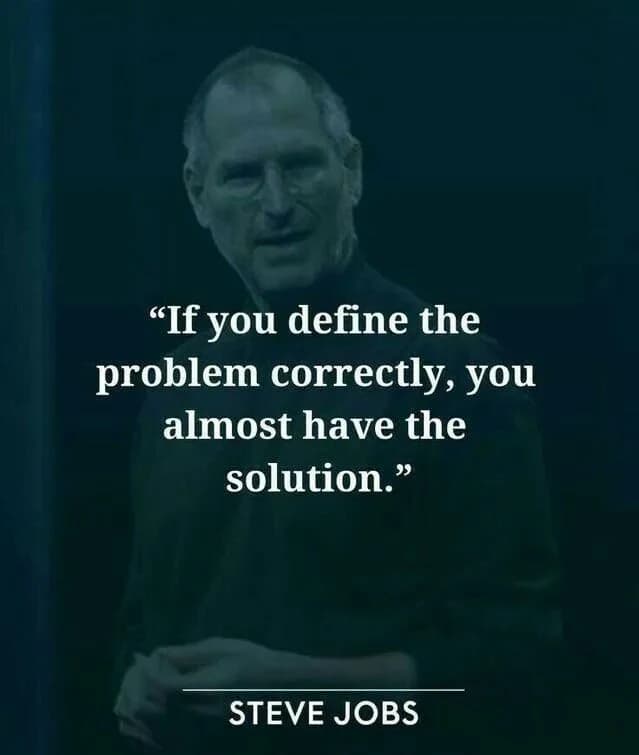
4. Define the right problem, and you have already solved half of it.
Using the examples above, if you cannot even identify which field a problem belongs to or distinguish its boundaries, you are probably still far from finding a solution. You may not even have asked the right question.
I learned this idea of “defining the right problem” last year from 怡静 (Yijing, a business consultant I know). Later, it became the slogan for her personal brand, appearing in her videos.
One of the core values and principles she distilled from consulting for businesses is helping companies define the right problems. After dealing with many growth-strategy and organizational issues, she believes that defining the problem is sometimes more valuable than providing a solution.
Only recently have I begun to feel the weight of that sentence, and my appreciation keeps deepening.
A few days ago, I happened to come across an image on X showing that 乔布斯 (Steve Jobs, Apple’s co-founder) had said something similar.
The deepest principles really can be simple.
I’m sharing it here as encouragement for all of us.
That’s all.