The Biggest Cost in Business Isn't the Price
We usually pay more attention to optimizing and balancing the system, its overall profitability, and the time involved.
A small story a few days ago got me thinking. Suddenly, I felt rather grateful that I had gone into sales in my second year after university.
I was probably around 24 then. Looking back, I'm grateful that I started in sales so early in my working life. Those years of experience had a huge influence on everything that followed.
Why do I say that? Let's start with this recent little story.
A few days ago, a friend on WeChat asked whether I could recommend a good AI digital-human tool. He needed one for his business selling products, and had already spent half a year exploring this.
My first thought was: there are plenty of tools like that, and making digital humans is quite straightforward. In 破局 (an AI learning community), we've run digital-human talking-head video sales bootcamps countless times. Each time, quite a few unexpected standouts from the community emerge and make a lot of money.
After a brief chat, he was excited. After half a year of exploring alone, he felt he had finally found his people.
So I recommended a digital-human platform developed by someone in the community. We had used it for digital-human videos in our bootcamps, achieved plenty of results, and the tool also had a good reputation in the market.
But he thought it was expensive.
I glanced at the price. To me, it looked fine—pretty normal. He said he would look into it some more.
Two days later, I sent him the WeChat contact of another founder in the digital-human business. This founder's product offered good value for money, so I thought it might suit him.
He replied that he thought all these digital-human companies and products were ripping people off. He could develop software himself, so he planned to research and build his own.
At that point, I wasn't quite sure what to say. Huh? So that was how he saw it! All right, then.
I could only say: sure, if you can build it, that's an option. But selling through digital-human videos is fundamentally about short-form video. What you actually need is marketing and customer acquisition, not digital-human technology itself.
After that, I felt the conversation had run its course. I wasn't planning to discuss it any further.
Because that isn't how a businessperson thinks.
So how does a businessperson think? What does commercial thinking look like?
When I look at a product or service, I don't just look at its price. I look more at whether it fits the context in which I need it, whether it can efficiently solve the needs and problems in that context, whether customers will pay me, and whether using it can generate profit and a positive return on investment.
If the ROI is positive, it's a product I can use. The moment I find customers willing to pay, and can use that product—even an imperfect one—to create value, I can start making money.
At most, while doing this, I might discover or develop other, more economical and useful products or solutions to replace the current one. When that happens, I'll earn even more revenue and profit.
Compare that with starting from scratch to explore and develop a new product. Who knows how long that will take? Don't forget that he had already spent half a year exploring. The time and resources between now and getting a result are costs he will definitely have to put in first, even before we consider whether he succeeds in the end.
In other words, he could have started earning as soon as he found a mature product that solved the problem. Instead, he was committing more than half a year of costs upfront, imagining that six months or a year later, his own product could win over all the customers and make big money.
This is a very common fixed way of thinking. Especially among people who work in technology.
I'm not saying that being price-sensitive is wrong, or that being committed to building a product is bad. I'm saying that a businessperson, thinking commercially, looks at relative price rather than the absolute price of a product.
If a product can do its part within the entire commercial service system, at a reasonable cost, allowing the whole system to operate and remain profitable, then it is a good product.
We usually pay more attention to optimizing and balancing the system, its overall profitability, and the time involved.
I suddenly thought of a useful business example: something I learned many years ago while working in sales.
We were a multinational company at the forefront of the global power industry. My team worked in machine service for large electric motors. Put simply, we replaced and repaired customers' electromechanical equipment.
Back then, we described an impossible triangle: price – delivery – quality (price, delivery time, and delivery quality).
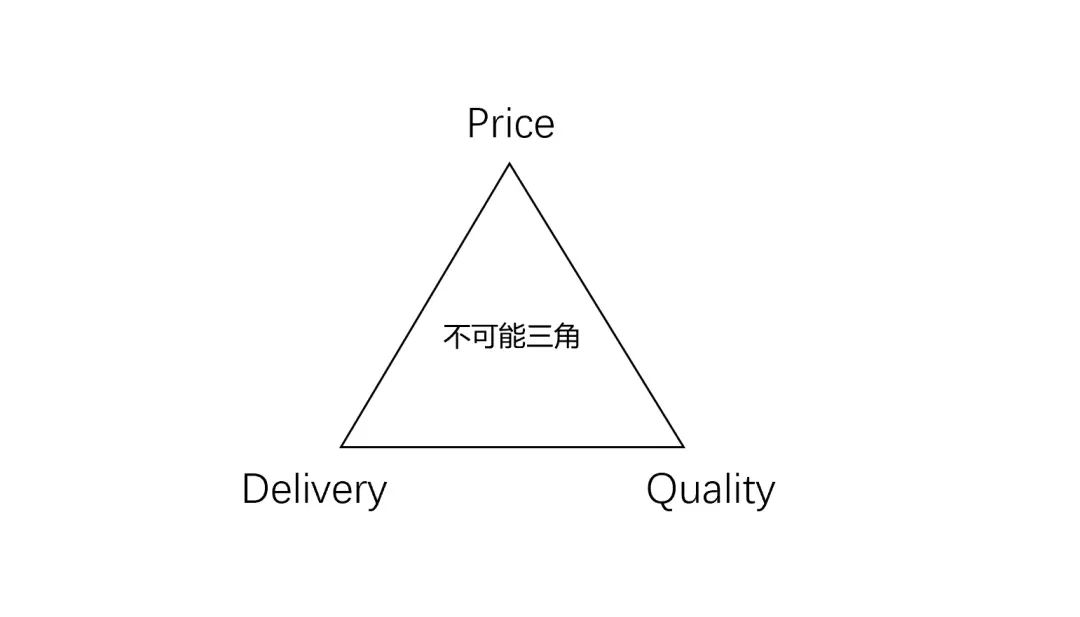
It meant that we couldn't make an order cheap, deliver it quickly, and provide excellent quality all at once. Those three factors usually cannot all be satisfied simultaneously.
If a customer wanted it fast, we had to allocate extra resources, which meant paying more. If they didn't want to pay extra, they had to accept normal delivery speed and quality. If they wanted it fast without changing the price, we couldn't guarantee the best quality. That is reasonable.
The same logic applies to today's story. It has its own impossible triangle: making money, time, and product.
If you want to start making money immediately or quickly, stop insisting on finding the ‘perfect’ product. Don't obsess over whether its price is the lowest in the whole market, or wait until you've built it yourself and driven the price down. You're competing for time and earning while the opportunity is there. If there is demand and customers can pay, you should get started.
If you want to build your ideal ‘perfect’ product, don't imagine that you can make money right now. You also have to bear the investment risk and accept that making money may be several months or a year away.
And by the time you have that ‘perfect’ product, the opportunity may no longer be there. Once you've missed the timing for making money, it may not come around again.
Thinking about this that day led to the reflection I mentioned at the beginning: I'm grateful that I went into sales so early in my life.
And I held two sales roles: one in channel sales, and one in direct customer and key-account sales.
Even now, looking back, I think working in sales is one of the best ways to develop a person's commercial thinking.
Those also happened to be years when I grew incredibly fast. I felt as if I was going everywhere and doing everything, with one goal: becoming good at sales. I did a lot, learned a lot, had a wealth of experiences, and achieved very good sales results.
More importantly, much of my business thinking and problem-solving ability was established during that period. In all the years since, right up to today, I still feel I benefit from it.
When closing a deal or winning a project, we often aren't looking for one product or one capability to be outstanding on its own. We look at the entire project operating system, considering how its products and capabilities can work together to maximize overall efficiency and benefit.
Those maximum benefits are for both ourselves and our customers. And customers are more receptive to the best solution after considering everything together, rather than simply the one with the lowest monetary cost.
I think this basic way of thinking and solving problems—looking for the optimal solution for the whole system—works in any kind of business collaboration.