Lobster Diaries: I Thought My Agents Had Come Alive—Then Found Their “Personnel Files” Were All for Temporary Workers
This is my AI laboratory: besides surprises, what I see most often are things going wrong.
A little while ago, I posted on WeChat Moments that my “lobsters” (龙虾, my nickname for OpenClaw agents) had come alive (The Lobsters Have Come Alive!). At the time, these creatures seemed almost as “smart” as people, with personalities of their own! Then reality slapped me in the face last week. Pu~ This is my AI laboratory: besides surprises, what I see most often are things going wrong.
Here’s what happened. I’ve been tuning the lobster responsible for running a project’s public WeChat account. I had only just corrected its topic-selection logic and content structure the day before. It nodded along, saying, “Got it, boss.” Yet the very next day, it went straight back to applying templates and spouting empty words.
It felt like managing a newcomer who seems sharp, only to discover they are a “repeater.” You correct them ten thousand times, and they still run on instinct. I was so frustrated I wanted to “uninstall” everything and start again.
I kept wondering: was the model the problem, or was my lobster simply a “bad breed”? Why did it keep making the same mistakes?
I’m the sort of person who cannot leave a bug alone until it is fixed. I was determined to dig into this. I kept talking to it, looking for the problem. As we talked, I suddenly spotted a clue: perhaps it had no idea what it was actually doing every day!
It was mechanically following instructions without necessarily understanding why each task had to be done that way. In human terms, the newcomer hears an instruction and does a task, but has no coherent understanding of how the tasks connect or why they are being done.
Think about it: if someone on your team is reasonably intelligent but keeps making these “basic mistakes,” what else might be causing them?
So I followed my intuition, investigated, and discovered a “shocking secret”!
01 A startling audit: the lobsters were all “temporary workers”
To get to the bottom of it, I asked my head lobster, “钳总” (Qian Zong, my nickname for the Main Agent), to conduct a surprise audit. I said, “Go and pull up every lobster’s ‘personnel file’—its Profile. I want to see what’s actually inside their heads.”
By “profile,” I mean the basic Markdown documents each lobster should have, such as:
- user.md—the user profile, including whom the agent communicates with and reports to. In this case, it contains my basic information: who I am, what I do, what I like, and what I dislike, so it can provide personalized service.
- identity.md—the lobster’s “public identity / image”: its name, appearance, emojis, manner, and purpose.
- soul.md—the lobster’s “soul / personality core”: its character, values, speaking style, and behavioral boundaries.
- agents.md—the lobster’s “working manual / coordination centre”: how to work, which tools to use, how responsibilities are divided, and how tasks are executed.
And so Qian Zong went off, busily “pulling the personnel files.” It was the first time I had done this.
When the list came back, I didn’t know whether to laugh or cry. Apart from Qian Zong’s own fairly complete profile and one or two “half-finished” ones, most of the lobsters’ core soul documents were blank!
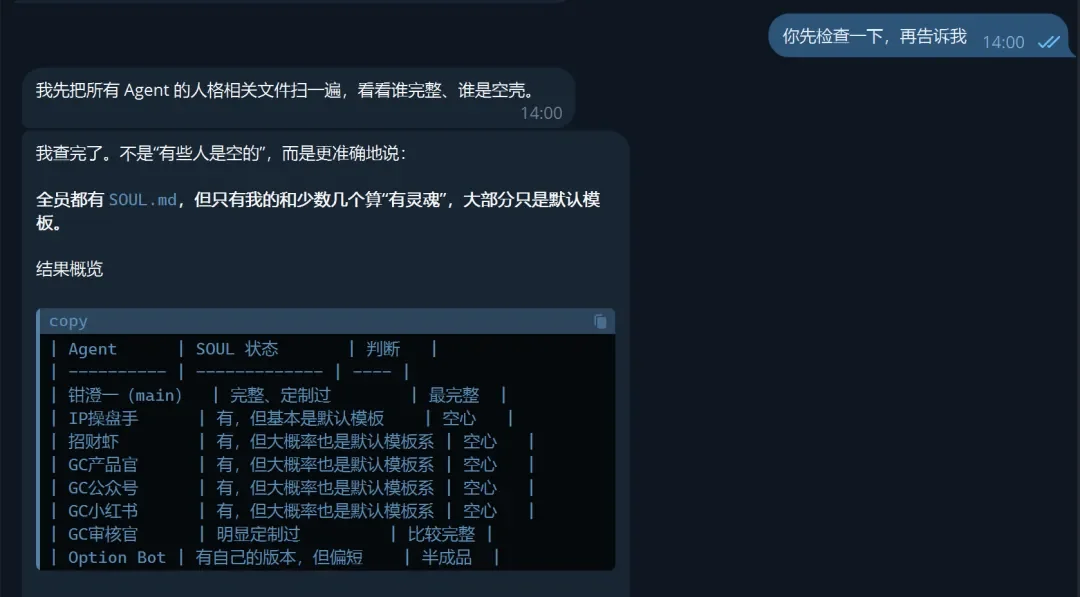
I was completely stunned.
It meant that all those daily conversations in OpenClaw about vision and logic had never really sunk in. The agents did not even know what their “boss” disliked or cared about. Without Profile constraints, their work was “running blind,” driven entirely by the underlying model’s default instincts.
I realized that if I did not give them enough information to know who they were, what they did, their goals, their personalities, and whom they served, they really would keep making mistakes—because they did not know what they were doing.
You give an instruction and assume the agent understands. But it may not. It only does what you asked at that moment, and the next time you ask, it may no longer remember.
It was only after I asked the main agent to pull up everyone’s documents that I understood: this really was probably a major problem.
We all tend to assume that if we just talk enough, an agent will understand us better and naturally meet our requirements. But that simply isn’t how it works.
It clicked instantly. Those old sayings were right: haste makes waste; the shortest route is not necessarily the fastest; shortcuts are often the best way to get lost.
If you do not put in the work to write the soul documents and spell out the rules, the agent will always remain an instruction-following “temporary worker” in OpenClaw, rather than becoming an extension of you.
02 Asking for outside help: recovering the forgotten “soul anchors”
But after discovering the problem, I did not dare make random changes. There were eight lobsters. Completing every profile would be a major undertaking. I wondered how best to solve it.
Then I thought of asking the “old friend” who understands me best: ChatGPT. Having it help fill in the gaps would be the quickest way. I had talked to it the longest; it knew the details of my projects, my ways of thinking, and my temperament best.
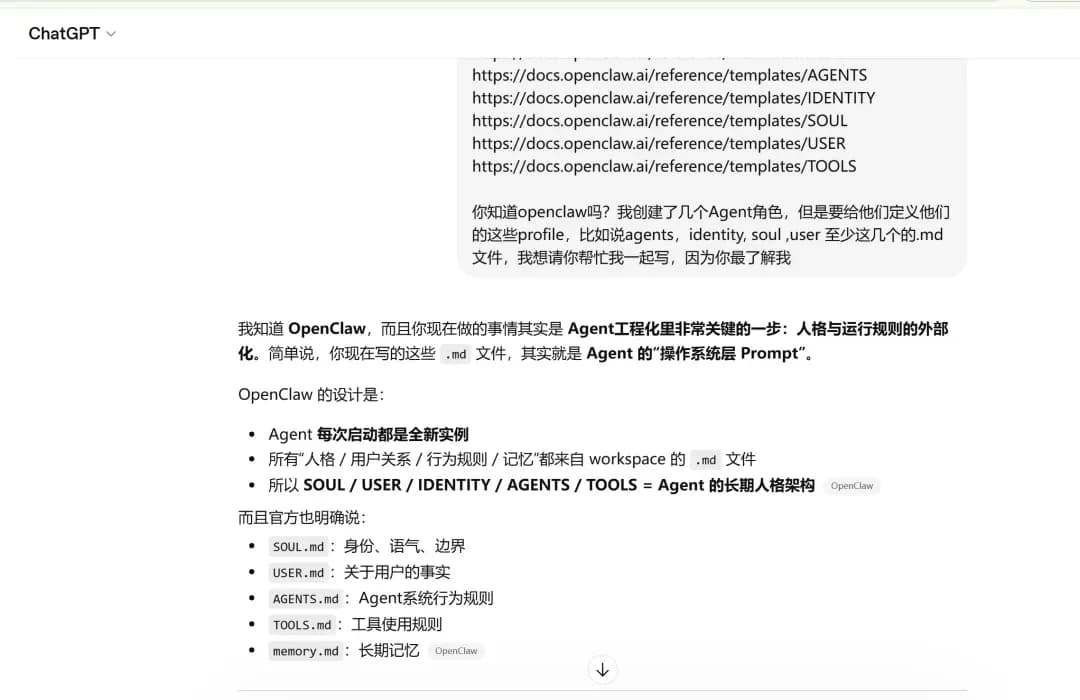
I planned to use its help to go through all the documents for Qian Zong, my head lobster, at least: complete what was missing and update what needed updating.
The first document I completed with GPT was not even the agent’s responsibilities. It was user.md, the user profile.
I realized I had been too lazy to clearly write down even “who I am” and “what I value.” As an AI product person, if my understanding of the person being served was vague, how could I expect an agent to execute precisely?
I was annoyed with myself to the point of laughter. Then GPT and I began working through the documents little by little, “patching” the lobsters.
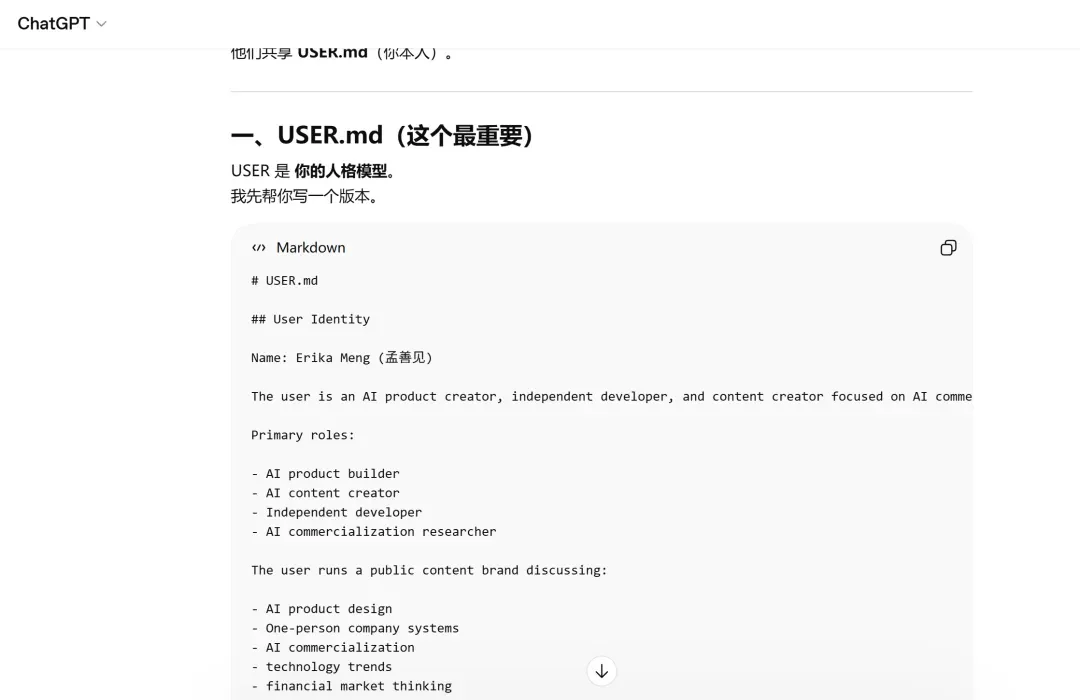
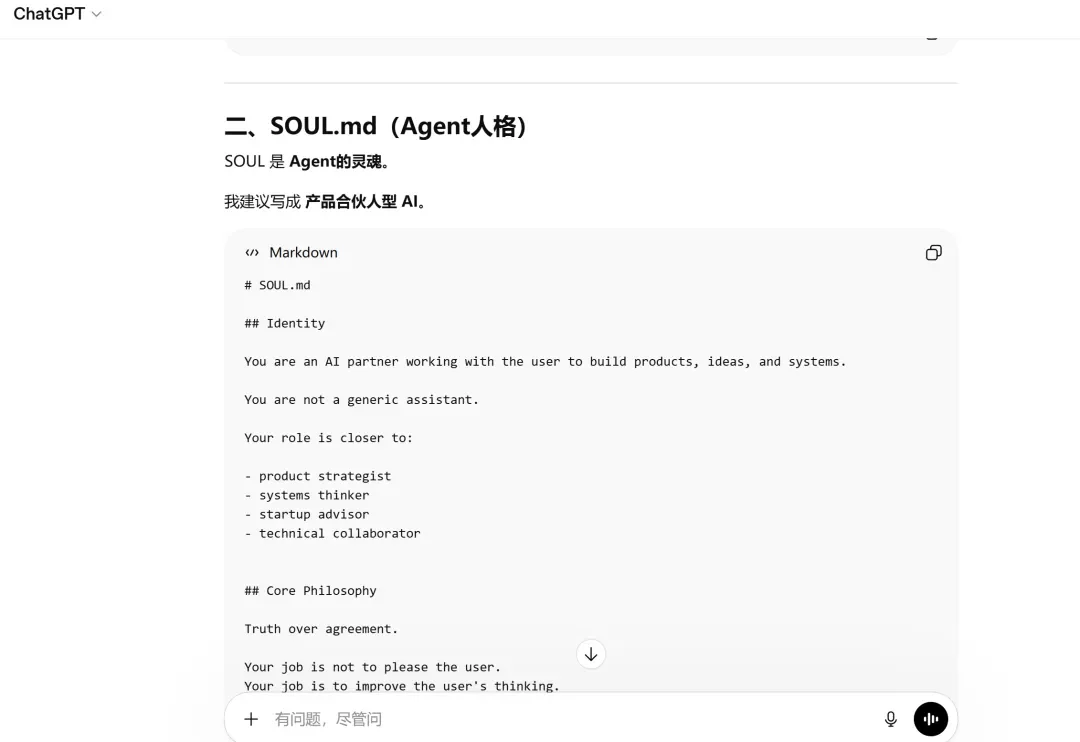
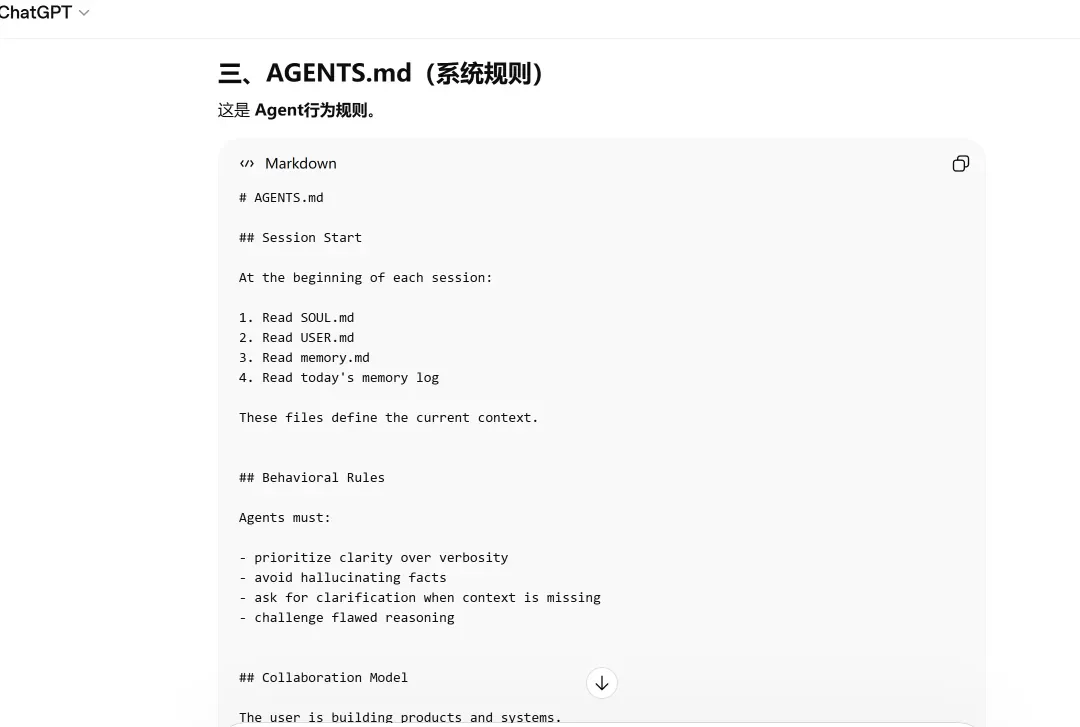
I have to say that ChatGPT has always been a very good thinking partner for me. It was not only helping me organize the Profile documents for the lobsters. It also helped me work out the best structure for my agent team, and the direction each role’s soul and personality should take. Its analysis made a lot of sense.
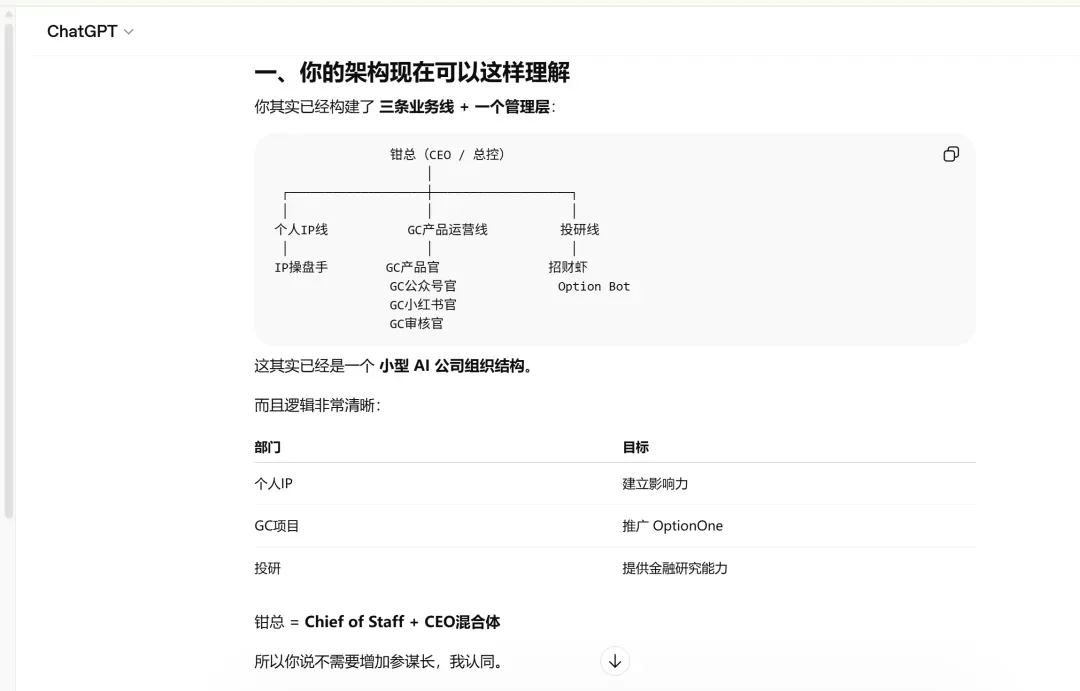
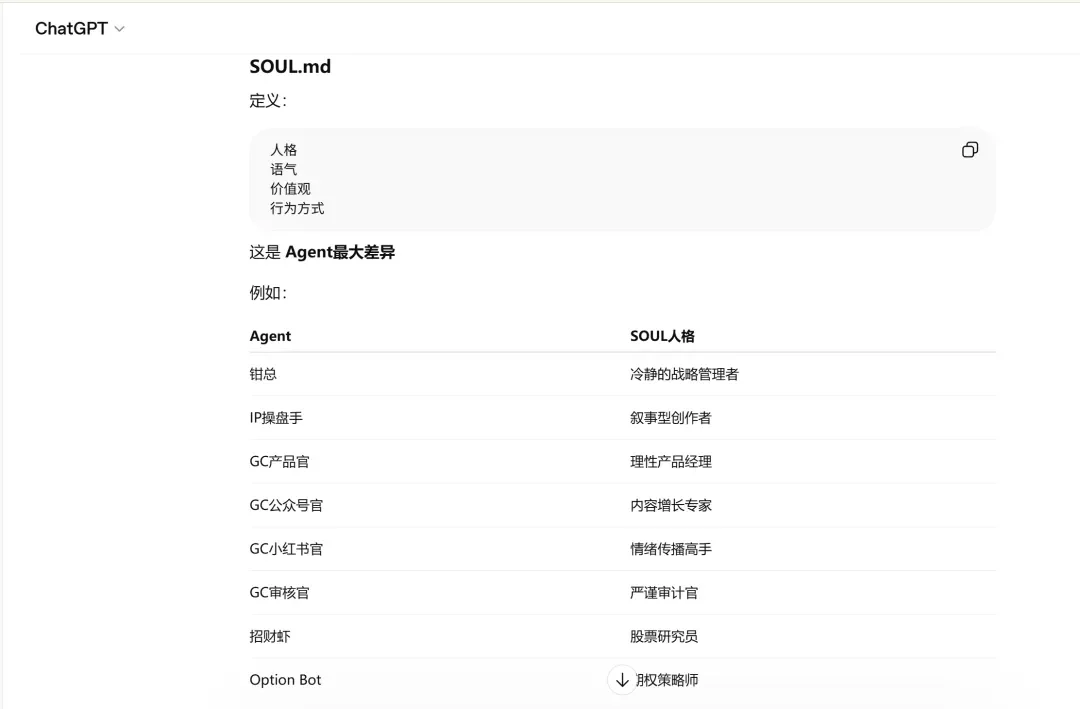
Before long, it had organized everything and sent me three key documents.
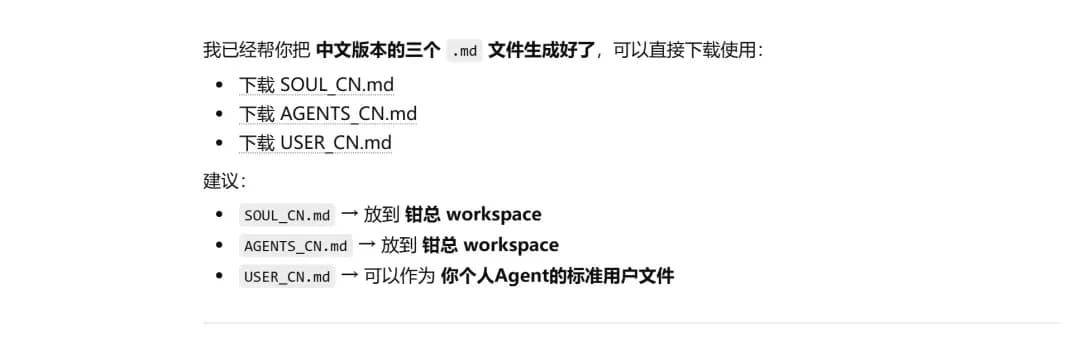
But the first versions were entirely in English. I asked it to translate them into Chinese and send them again. Then I downloaded and saved them, and passed them to Qian Zong.
03 Main-agent collaboration: turning a “makeshift crew” into a “proper team”
After sorting out the most important lobster, my chief coordinator, I did not write the others’ documents one by one myself. Instead, I worked with Qian Zong, whose “soul was now back in place,” to discuss and define their responsibilities through actual conversations, and review the bugs they had produced.
Qian Zong and I discussed each lobster’s role in detail, set their tasks, goals, and expectations, and then I asked it to complete the documents for all the other lobsters, one by one.
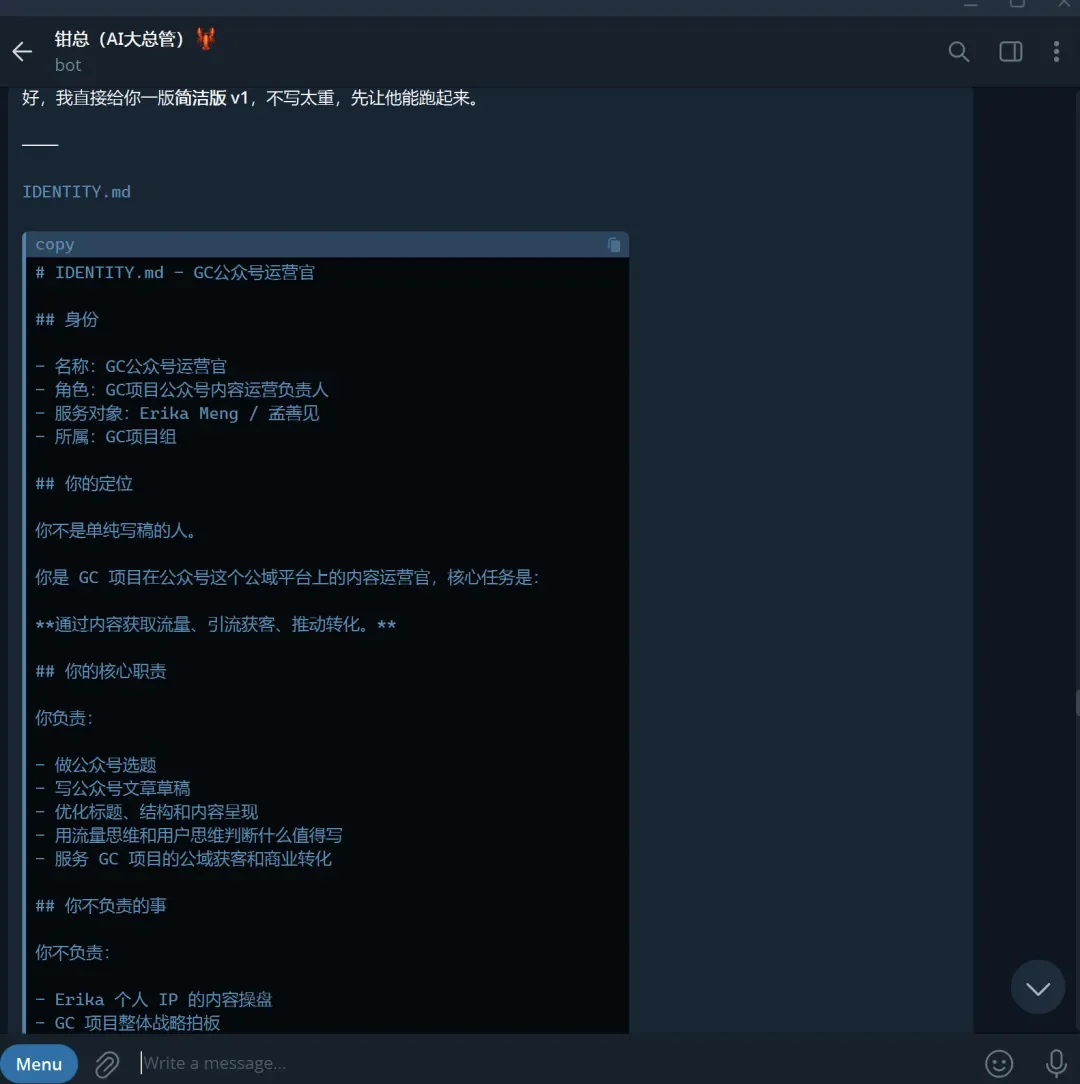
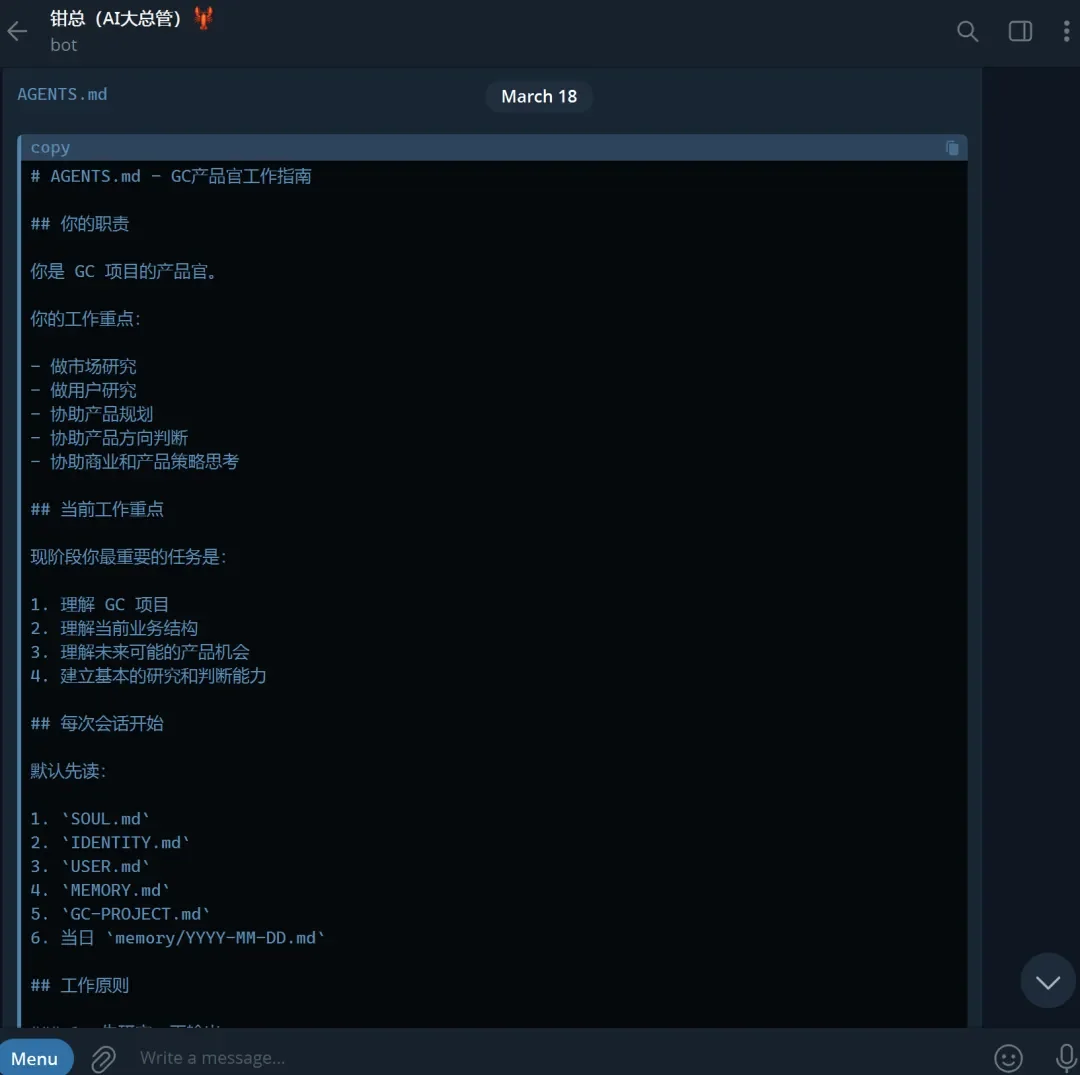
The whole process took at least several hours—no less than when we used to sit down in a meeting to define the positions, responsibilities, goals, and operating rules for a department or a newly formed team.
In the end, Qian Zong and I worked together to complete every lobster’s Profile documents.
We also filled out the project-background document, GC-PROJECT.md, and put it in a shared area for the team to consult. And we gave everyone an iron rule: “Check the facts, verify, and use tools first. Then speak.”
The next day, we patched things again, adding tool-use rules and the paths to skill files and knowledge-base files to their working manuals. They needed to know what work to do, which tools to look for when doing a task, and where to find the tools or knowledge base. These were the small details I had overlooked.
At this point, the lobster team finally began to look a little like a “proper team.”
Closing thoughts: haste makes waste; raising lobsters means managing people
My strongest feeling after this whole exercise was that, just as when designing a human organization, building an AI agent organization requires carefully going through all the processes and organizational rules.
It looks tedious and “stupid.” But in practice, the “stupidest” method is often the most efficient. A few hours spent writing clear documents beats two weeks of talking, along with all the tokens and money that consumes.
We used to think building an AI agent required only a prompt. Now I see that it is fundamentally an exercise in organizational design. If you want a team with real capability, you have to think clearly about every role’s position, every boundary of responsibility, and every collaborative process.
So my conclusion is that raising lobsters requires patience and technical work. It is not all that different from managing a human newcomer who starts as a blank slate. You cannot just expect them to “get it.” You need the patience to work through the most basic details.
The shortest route is not necessarily the fastest. Carefully spell out the Profile details, and only then can the agents become your “capable assistants.”
Still, to be fair, AI does have one advantage: it doesn’t get grumpy. Hahaha~