Learning from Other People's Failures Is Excellent Value!
But each of us has limited resources, energy, and time. They can't simply be replicated. Nobody can withstand the depletion caused by too many failures.
I've recently had a fairly profound realization, one that I think is worth sharing with AI entrepreneurs, especially those from technical backgrounds.
Why should we learn from failures? Whether the experience is your own or someone else's, it is worth studying and learning from. Failures in entrepreneurship and business are particularly valuable.
This realization came from my own observation: many people starting AI businesses today come from technical backgrounds. At least in the early stages of a new technology, quite a few of those participating in this wave of AI entrepreneurship used to work in technology.
They are sensitive to new technologies and technological change, but may be much less sensitive to business.
My sense is that, since AI emerged, we have seen many changes in productivity, improvements in efficiency, and reductions in cost. These effects have fairly clear manifestations and examples; they are quite tangible.
People can see AI's impact on society through very concrete developments, such as layoffs at many companies. These are things we can genuinely observe.
But so far, I haven't seen AI bring about any truly fresh, eye-opening transformation in business models. I haven't.
In the three years since ChatGPT launched, almost all large-model companies and AI product and application companies have continued using the business and profit models of the previous ten or twenty years of the internet era. There hasn't been a fundamental change.
For example, foundation-model service companies sell API access and charge for model calls. AI applications use the traditional SaaS subscription model. Others build custom agents for businesses or provide outsourced software services. These models are much like the ones we had in the internet era. There hasn't been some major change, some surprising novelty that nobody has ever seen before.
So if you're an AI entrepreneur, part of a startup team, or the owner of a startup, and suddenly say: I've got an idea! It's absolutely a genius idea! Wow~ nobody in the world has thought it through as perfectly as I have. I'm definitely the originator of this idea......
Basically, in all likelihood, that is your own illusion.
In business thinking, we tend to agree with the saying: there is nothing new under the sun.
What you've thought of has probably already occurred to someone else, and someone has probably already done it. Some may have succeeded, others failed. It very likely happened already; you just don't know about it.
So when you think you have an unbeatable startup idea, before you start building it, my sincere advice is: search first for whether anyone did the same thing in the internet era. Chances are you'll find something.
And now, with AI's help, you can quickly find the information you need in a vast ocean of information.
Then you'll learn how many companies built this product, and how many failed at it.
If you discover that others tried this model and many companies failed—or didn't quite fail, but struggled and eventually all pivoted to another business format—then, to some extent, that is a 99% indication that this path may not work.
If the path doesn't work, its business model may not work either. And if the business model doesn't work, the commercial logic or product-market fit is off. In other words, this model or product may not fit this market, or the needs of this group of people.
A business model, or commercial logic, is the underlying logic that determines whether a business can exist and develop healthily. You can build layers of capabilities and functions on top of that logic.
But it's like constructing a building. If the foundation is shaky and unstable, or is a ‘false need’ whose underlying logic doesn't exist or hold up, however high you build on top, it will collapse. It is meaningless.
Even if we are entering an era with a new technological paradigm, suppose a model that many predecessors have tried and found unworkable hasn't fundamentally changed today, or AI hasn't introduced a new variable that changes and resolves its original problem.
Then bringing that model into today, into the AI era, still won't make it viable or successful.
So I think the best and simplest way for many AI entrepreneurs or teams to avoid traps, pay less in costly lessons, and take fewer detours is to check whether anyone has walked this path before—and whether they succeeded or failed.
What was the probability of success? Where did failures occur? Has the factor that caused failure changed in this new era? If I can't change that factor either, then it's best to avoid that path altogether.
That's why I think extracting and learning lessons from failed business cases and entrepreneurial experiences offers excellent value, especially when resources and financing are not particularly plentiful.
For an entrepreneur, it's a very good habit and approach before making any decision. It can save a lot of detours.
Take me, for example. One advantage I have is a large library of business cases in my head. That includes projects I personally participated in that failed, as well as many classic cases involving others that I learned about at university and at work.
With that case library, when I look at a new entrepreneurial model, a new business model, or whether a new product should be built in a particular way, I have many references and benchmarks—things to compare it with.
I use past experience to judge: if we build the product this way, what problems will appear at launch? At some later stage, if we add this feature, what other problem will emerge?
You develop a sense of that rhythm, making projections and judgments stage by stage.
If I design this model this way, what situations or user feedback might arise?
If that happens, can I deal with it?
If I want to iterate into a different model and product format at the next stage, what data should I collect in the current stage, and how should I validate it?
And so on...
In short, you have a whole set of ‘instincts’ for judging whether something should be done this way. And many of the things we're doing now are, in all likelihood, nothing new.
There really is nothing new under the sun. Many people have done these things before. Your commercial thinking, business analysis, and library of cases you've encountered can help you take fewer detours as an entrepreneur.
Do something repeatedly, enough times, and you develop a feel for it. That's what I mean by an experiential instinct.
The same applies to entrepreneurship and failure. After enough repetitions, setbacks, and lessons learned, you develop an instinct for avoiding failure, and the likelihood of success improves.
But each of us has limited resources, energy, and time. They can't simply be replicated. Nobody can withstand the depletion caused by too many failures.
Since we can't afford to fail that many times ourselves, studying and learning from predecessors' failures, entrepreneurial experience, and business experience—and developing the methods and habit of asking experienced people about specific problems, or finding an answer we can validate at minimal cost—amounts to gaining another life as an entrepreneur. That's a very worthwhile investment, excellent value.
I've essentially finished the main point of this article. Let me extend it with a personal reflection:
Lately, I genuinely feel that every ‘failure’ is paving the way for the time when you choose the right direction and get something right. It is preparation.
I seem to remember 雷军 (Lei Jun, Xiaomi's founder) saying something similar: all the setbacks and failures you encounter, even the time spent on apparently meaningless things, may become a tremendous asset in the future.
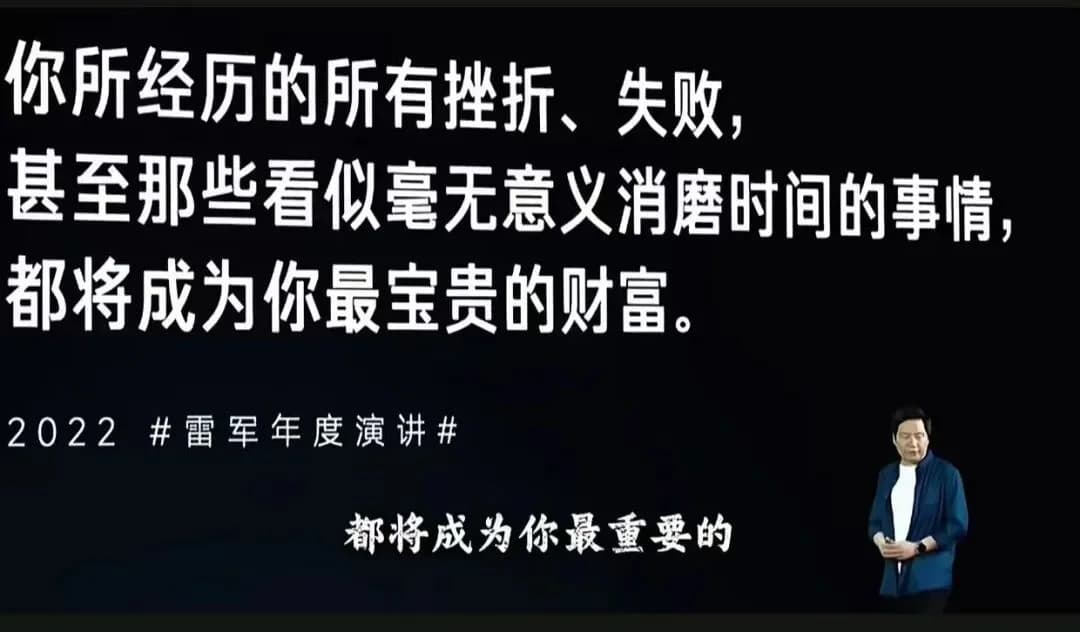
So keep going, friends! Today's failures aren't something to fear. They may become the foundation of your future success.
No path in life is walked in vain. Every step counts.
That's all.