Models Keep Getting Stronger, Yet the Gap Between Ordinary People Is Growing
Product capability is, in fact, the ability to anticipate future complexity.
Lately, it seems that a new large language model is released every little while.
Stronger reasoning, better coding, longer context windows, lower costs.
On the surface, these look like one leap in capability after another.
But if we take a longer view, an interesting change emerges:
The gap between models is narrowing, while the gap between people is widening.
OpenAI, Anthropic, Google DeepMind, DeepSeek, 豆包 (Doubao, an AI assistant), and KIMI are all moving in the same direction: making models more general-purpose, more reliable, and easier to call.
That means one thing—
Coding, generating content, organizing information, and doing analysis are rapidly becoming ‘commodities.’
Skills that once required years of training are now being compressed into a single conversation.
The scarcity of individual skills keeps declining.
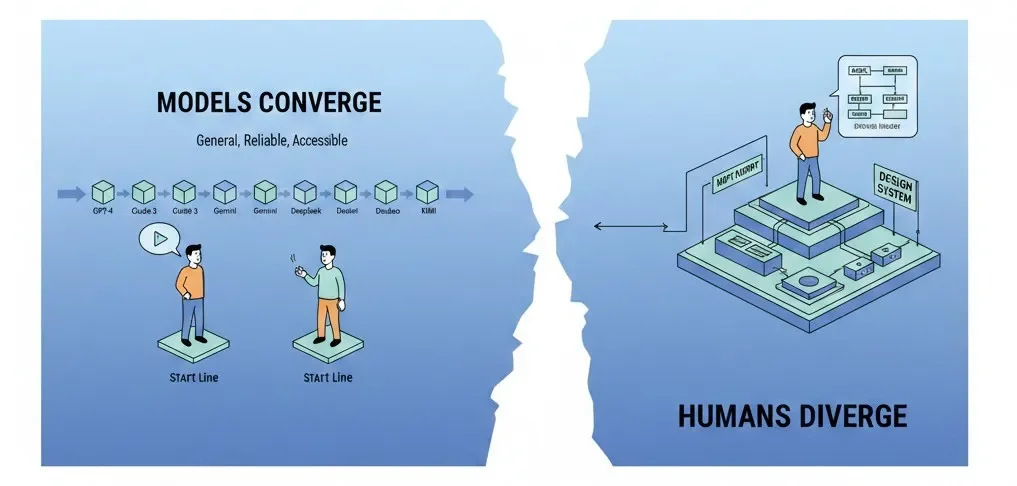
01 As models grow stronger, genuinely scarce capabilities start to shift
Many people naturally conclude: ‘Ordinary people now have more opportunities.’
But my feeling is exactly the opposite.
Models have indeed lowered the barrier to getting things done. At the same time, however, they are amplifying differences in another capability.
That capability isn't coding. It's the ability to organize models into a system.
Look carefully, and you'll find that most people still use models in essentially the same way: enter a sentence → wait for a result.
A small minority use them differently:
Break down the goal → design the steps → define the inputs and outputs of each step → then bring the model into the execution.
On the surface, both are ‘using AI.’
But fundamentally, one is talking to a model,
while the other is drawing a flowchart for it.
This is where the gap begins.
02 What really holds most people back is the ‘definition’ step
Many people think coding is the hardest part of building a product.
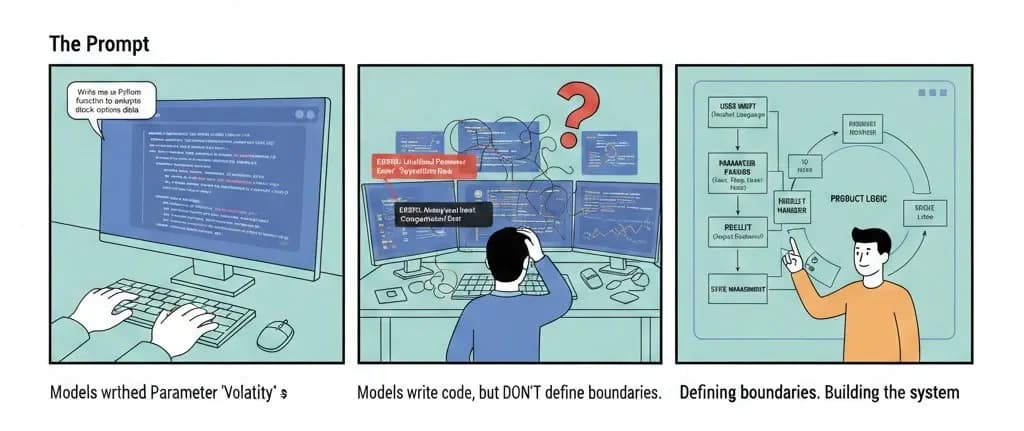
But once you've actually done it, you often discover that the difficult part isn't the code. It's defining things.
- Where do the parameters come from?
- Can they be empty?
- What happens when something goes wrong?
- How do different states transition?
A model can help you write functions, but it can't define the boundaries for you.
If the boundaries are fuzzy, the more the model produces, the messier the system becomes.
That's why some people use the strongest models but still never get beyond a demo.
A demo answers ‘Can it run?’ A product answers ‘Can it keep running reliably over the long term?’
I had a very typical experience while building an AI tool for options strategies.
At first, I thought the challenge was getting the model to write out the strategy structure.
Later, I discovered that what was really blocking me came even earlier—
Should a user's natural-language input be required to resolve into four fixed parameters?
If one parameter is missing, should we report an error immediately, or guide the user through supplying it?
If the user's wording is ambiguous, should we handle it conservatively, or let the model ‘guess’?
Fundamentally, these aren't model problems. They are trade-offs at the product level.
Until those boundaries are thought through, the overall experience will be unstable, however capable the model is.
03 Product capability is fundamentally about anticipating complexity
As models grow stronger, what is genuinely scarce is quietly shifting.
From ‘Can you code?’ to ‘Can you design a structure?’
From ‘Can you generate content?’ to ‘Can you generate structure?’
From ‘Can you use tools?’ to ‘Can you turn tools into products?’
The ability to turn something into a product is fundamentally the ability to compress recurring problems into a system.
You don't rethink everything each time you encounter a problem.
Instead, you embed that thinking in a structure beforehand.
To put it more plainly:
Product capability is, in fact, the ability to anticipate future complexity.
From the very beginning, you have to assume things will become complicated.
That, in itself, requires patience with complexity.
04 So AI hasn't made the world fairer
Many people say AI puts everyone on the same starting line.
But the reality may be that AI hasn't made the world fairer. It has simply moved the focus of competition.
Previously, the contest was about who possessed more skills.
Now, it is about who can better handle complexity.
People who think structurally will keep being amplified.
Those without that ability will become more dependent on models, and more anxious.
This is a process of divergence happening quietly.
05 So what should ordinary people do?
My own experience is: don't pursue an enormous system from the outset.
Start with three very small actions.
First, build a tiny complete loop.
Even if it's just a form + a processing workflow + a result output.
The goal isn't perfection. It's completeness.
Second, force yourself to spell out the inputs and outputs.
You don't need a tool. Writing it on paper is fine.
You'll find that many problems reveal themselves the moment you start writing.
Third, improve only one part at a time.
Don't try to tear everything down and start over all at once.
The ability to build systems is fundamentally accumulated over time.
A final thought
Models will keep growing stronger. There is no doubt about that.
But what really determines where you stand has never been which company's model you chose, or which version you use.
It is whether you are cultivating an engineering and product mindset.
As large language models enter the engineering era, what really separates people isn't the parameter count, but—
Whether you can organize capabilities into a system.