Behind $100 Million in ARR in Eight Months: How Emergent Uses a Consumer Approach to Win the Business Market
A look at Emergent’s technical choices, target users, and revenue model: how a self-serve product reaches the business market, and what that approach suggests for my own AI product explorations.
I have been looking into a few AI application cases over the past several days, and Emergent really caught my attention. I got a little excited reading about it, because what it is doing resonated with—or validated—an idea I had been thinking about. I felt this was a case well worth unpacking.
First, the numbers:
Launched in June 2025, it had reached $120 million in annualized revenue, 200,000 paying customers, and a $1.5 billion valuation by July 2026. It took just over a year to go from graduating from YC to becoming a unicorn.
But what I kept coming back to was not the numbers. It was the choices the company made along the way. Each seemed to go against the prevailing approach, yet each looked right in hindsight.
I think that is the secret behind its becoming a unicorn in a year. So today, let’s look at how Emergent took shape as a product.
It Is Not Just Another AI Coding Tool
If Cursor, Claude Code, and Codex address the need: “I know how to develop software. Help me write it faster.”
Emergent addresses: “I do not know how to develop software, but I know what I want to build. Make the product for me.”
Tell it, “Build me a vehicle-dispatch system for a logistics company,” and it will not simply spit out code.
It asks you questions in return: How many user roles are there? How does cargo move through different statuses? Do you need payment integration? Then it handles the frontend, backend, database, authentication, testing, and deployment itself. You do not have to touch a line of code throughout the process.
The CEO has used a particularly apt description:
Cursor sells an AI programmer.
Emergent sells an “Engineering Team in a Box.”
In other words, it does not just help you write code. It takes care of architecture, development, testing, deployment, and operations for you.
This is how Emergent deliberately differentiates itself from products such as Cursor and Claude Code. It abstracts away the software development lifecycle, so users do not need to understand code, error messages, or server deployment.
One example stuck with me. A roofing company had been using five separate tools for CRM, quotes, payments, scheduling, and customer outreach, spending roughly $1,800 a month on software. The owner used Emergent to combine those five systems into a business platform of their own, bringing the cost down to $100 a month.
So the market it is really replacing is not “coding tools.” It is the unmet demand for software that was never built because software was too expensive.
It is not fighting over an existing pie. It is making a new one.
Six Months Under Wraps, Until They Reached Number One
But Emergent did not know from the outset that this was what it wanted to build.
Its founders are twin brothers, Mukund and Madhav Jha. The older brother, Mukund, was previously co-founder and CTO of the Indian quick-delivery company Dunzo. Dunzo had experienced both rapid growth and serious difficulties, giving him muscle memory for getting things running amid chaos. The younger brother, Madhav, followed a more academic path: a PhD in theoretical computer science from Penn State, followed by a role as a core member of the founding team behind Amazon SageMaker.
In late 2023, the brothers spoke extensively with major AI labs and reached a conclusion: AI agents taking over software development was going to happen, and it would happen on an enormous scale.
When they first entered Y Combinator, they were actually working on automating UI testing with AI. It was a familiar kind of idea: developers have a tedious job to do, so let AI do it. They could easily have ended up building an AI testing company.
But on their first day at YC, they told YC they wanted to change direction.
While working on it, they had suddenly realized: if AI could already operate interfaces, understand software logic, and find bugs, why not let it handle the entire software development process?
This was Emergent’s first important pivot: redefining the boundaries of the problem.
Once the direction was set, the conventional playbook would have been to find a pain point, build an MVP, and launch quickly—letting users generate an app with a single sentence.
But Emergent did not do that.
It went the other way: for six full months, it did not work on the product, growth, or users. It focused on just one thing: making its coding agent the best in the world.
Only after its agent took first place on SWE-bench, a respected benchmark for coding ability, did the team feel that the underlying technology was finally good enough.
In a traditional startup, this would be dangerous. It could easily become a case of having a hammer and looking for a nail. But in an era when AI’s underlying capabilities can suddenly leap forward, it can make sense.
Once model capabilities undergo a qualitative change, product forms emerge that simply could not have existed before. The founding team first has to establish whether something that used to be impossible has now become possible.
That is Emergent’s second distinctive choice: push the capability far enough first, then find the market.
The Technology Was Ready. Who Would Buy It? They Chose the Hardest of Three Paths
With the technology in place, there were three paths ahead.
The first: sell to enterprises. Traditional B2B means long sales cycles and extensive customization, too much for a startup to handle.
The second: sell to developers. Cursor and Claude Code had already turned that into a fiercely competitive market. It would be difficult to offer a fundamental difference on the dimension of “writing code faster.”
They chose the third path, deliberately: sell to the people who needed software most but had never had the ability to build it.
Emergent made what may have been its most important decision: do not compete with everyone else for programmers.
They approached the question from another angle: if AI can already write software, why should the person using it have to know how to write software?
The target user shifted from “programmers” to entrepreneurs, small-business owners, and domain experts—people who understood their own pain points better than anyone, but had never been able to turn those problems into software.
That was the step that truly opened up the market.
The later numbers validated the choice:
By February 2026, about 70% of Emergent’s users could not write a single line of code, and nearly 40% were small-business owners. Customers included trucking companies building freight-tracking systems, factories building enterprise resource management systems, construction companies handling project management, and property-management companies creating internal CRMs.
What these people built were not toy demos. They were systems running in production and in their businesses.
One factory owner in Mexico even built an entire factory-management system with Emergent, which eventually had 500 employees using it every day.
So Emergent’s real product-market fit, or PMF, was this: people who would never have bought a coding tool were paying to “build software” for the first time.
Those are two very different things.
Its real target was not the “coding-tool market.” It was software that previously would never have been developed because it cost too much.
It was not taking a slice of the existing pie. It was creating an entirely new one.
Growth Is Going Straight Up, but ARPU Is the Interesting Part
Emergent officially launched in June 2025. After that, its numbers climbed at a remarkable pace.
About two months after launch: $10 million in ARR and 700,000 users.
Three months: $15 million in ARR and 1 million users.
Five months: $25 million in ARR and 2.5 million users.
Seven months: $50 million in ARR and 5 million users.
Eight months: $100 million in ARR, 6 million users, and 150,000 paying users.
By July 2026: $120 million in ARR, 200,000 paying customers, $230 million raised in total, and a $1.5 billion valuation.
This curve was not bought by burning money on advertising. Mukund mentioned a detail on the YC podcast: there was no single breakout moment; growth accelerated all the way through. The product itself was an acquisition tool. Users built things on it, and those things became its best advertisements. Colleagues and peers saw them and naturally came to try it.
Emergent’s business model is not a pure subscription. It combines subscriptions, usage-based credits, deployment and hosting, and enterprise plans.
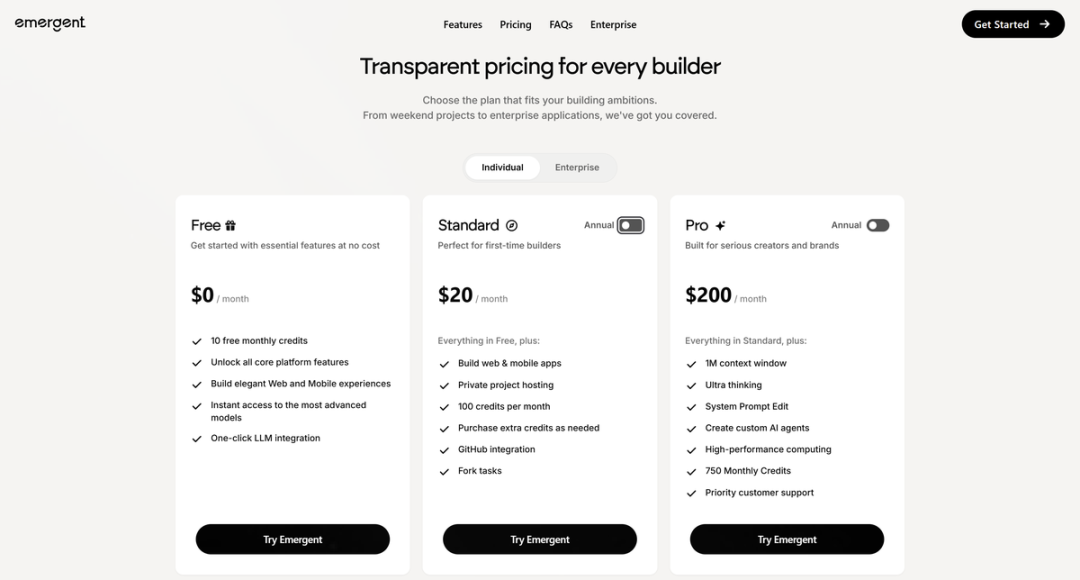
The official individual plans currently broadly consist of Free, Standard, and Pro, with Business and Enterprise above them.
The official pricing page lists Standard at around $20 a month with 100 credits, and Pro at around $200 a month with 750 credits. Pro adds capabilities such as an extra-long context window, Ultra Thinking, Custom Agents, and high-performance computing. Business and Enterprise bring in team collaboration, SSO, RBAC, VPC, self-hosted databases, audit logs, and other enterprise capabilities.
This is a very smart business model.
Users are not simply logging in to take a look. If they are genuinely developing, deploying, and using a product on Emergent, the more successful that product becomes, the more they use the platform. The more they use it, the more revenue Emergent earns.
And once a production application is deployed on its infrastructure, both switching costs and retention are likely to be much higher than for a typical AI chat product.
So hosting may be closer to its real future moat than “AI writing code” itself.
There is an interesting business metric here that, to some extent, validates the success of this model.
Let’s make a rough calculation of its ARPU, or average revenue per user:
ARPU = $120 million ARR ÷ 200,000 paying customers
= $600 per year per customer
= $50 per month per customer
The entry-level price is $20, but each user actually pays an average of $50. That is 2.5 times the listed price.
This gap tells us something: users are not just trying it out. They are actually running businesses on it.
As an application becomes more complex, it consumes more of the allowance, so users naturally buy more credits. As they keep using it and find it worthwhile, they upgrade from Standard to Pro. Someone enjoys using it, brings in their team, and moves to a team plan.
Revenue growth does not require persuading users to pay all over again at every step. The more deeply they use the product, the more they pay—and they do so willingly.
This is very different from ordinary office-productivity SaaS. SaaS products worry about users arriving and then leaving. Emergent’s users are building business assets on the platform. Once those assets are built, switching costs rise and churn naturally falls.
It earns more than subscription fees. It earns a “commission” on the success of its users’ businesses.
That is the real PMF signal: not simply that someone is willing to pay, but that after paying for the entry-level plan, they willingly pay more. It shows that the product has become deeply embedded in their business.
At $100 Million, the CEO Started Questioning His Own Business
One last thing genuinely surprised me.
When Emergent reached $100 million in ARR, its CEO said publicly that vibe coding carried two risks: first, the software might not be good enough; second, the future might not need “software” at all. If AI can query data, send emails, and update a CRM directly, why build a software interface first?
He even suggested that software might be the BlackBerry between Nokia and the iPhone—a transitional product. His own $100 million business could eventually be replaced by AI agents too.
So another evolution of the product followed:
In April 2026, Emergent launched Wingman, an AI assistant that lives in WhatsApp and Telegram. It connects to Gmail, calendars, Slack, and CRMs to help manage schedules, send emails, and handle operations. A company building “software development” tools had begun building “AI employees.”
If this direction works, the path of evolution is clear: develop software → deploy software → run software → operate a business.
From helping people build software to helping them run companies. This may be Emergent’s real long-term story.
Why I Say It “Uses a Consumer Approach to Capture Business Value”
This is the point I most wanted to discuss in this piece.
It is also what I meant at the beginning when I said Emergent had given me so much excitement and food for thought. The most striking part is that it uses a consumer approach to capture business value.
My background is much more in B2B than B2C. I know how heavy traditional B2B work can be, and how poorly suited it is to a one-person business or a small team. It can easily drag you down. So I have kept wondering whether there is a lighter way to reach the value in the business market.
Seeing Emergent that day made something click. It perfectly illustrated the product path I had imagined.
The traditional path for B2B software is:
Sales approaches a company → finds the CIO or department head → demo → pilot → procurement → contract → deployment → training → employees start using it.
A long chain, slow decisions, and heavy implementation work. A startup team considering this route really has to ask how many lives it has to spare.
Emergent takes a completely different route:
A business owner, an operations person, or a business lead signs up independently → uses it themselves → builds a system → colleagues start using it → the whole company comes to depend on it.
Acquisition, usage, and payment all work in a consumer-style way, but the value ultimately created is at a business level.
There is a beautiful mismatch here:
The product is simple enough to feel like a consumer product. The problem it solves is valuable enough to belong in B2B.
A factory owner in Mexico built a complete management system on Emergent, with 500 employees using it every day. That is textbook business value, achieved without a traditional B2B sales process.
It actually breaks two assumptions that traditional B2B software takes for granted.
The first: software is produced by software companies. Salesforce makes CRM, SAP makes ERP, and businesses buy them. On Emergent, businesses produce their own software.
The second: the enterprise is the purchasing decision-maker. The company handles procurement, contracts, implementation, and training. On Emergent, one specific person starts using it, and the company gets drawn in later.
A new value chain emerges:
AI platform → an individual who understands the business → custom software → enterprise workflows.
The individual is the entry point, the business provides the use case, and the company is the ultimate beneficiary.
When AI brings down the cost of producing software, a B2B business may no longer need to operate in the traditional B2B way.
That is what I find most compelling and exciting about this entire case:
The rules of the game have changed!
What This Case Taught Me Most
My biggest takeaway from Emergent is not to copy it and build an app builder. It is the way of thinking it offers:
Understand a high-value business problem, but redesign how you enter that market. Make a product that users can buy, use, and get the full value from on their own, removing as much pre-sales, implementation, and delivery work as possible.
Turn B2B expertise into something that feels closer to a consumer product.
In one sentence:
Make B2B lighter, rather than smaller.
This could even become a framework I use to evaluate future AI product opportunities.
A company like Emergent is hard to replicate. But its way of thinking is something everyone building AI products can take away.