No Funding, $1 Million ARR in 117 Days: How Did This AI “Wrapper” Reach $10 Million in Three Years?
Sometimes strategy is simply going a little further with the user at each step. Looking back and connecting those steps, you find that a path has already emerged.
Sixteen Twitter followers.
The product went live at 1 p.m. Thirty minutes later, the first paying customer sent money. Ten minutes after that, the second. An hour later, the third.
No funding, no team, and not a penny of marketing budget.
117 days later, it reached $1 million in ARR—annual recurring revenue.
Three years later: $10 million in ARR and more than 10,000 paying business customers. When it reached $8 million, the entire company had just 18 people.
The product is called Chatbase. And what it did at first was so simple that you might look down on it today:
Upload a PDF, then chat with it.
A standard AI “wrapper” product. No model of its own, virtually no technical barriers, and hundreds of similar “chat with your PDF” tools appearing within a few months.
You would think the most likely ending for such a product would be to disappear quietly into some ChatGPT update.
But it did not die. It survived, then grew, step by step, into a real enterprise AI company.
I spent quite a while unpacking its three-year growth path. My strongest feeling afterwards was that the most valuable part of this story was never “$10 million in ARR in three years.”
It was how an AI wrapper with almost no barriers to entry managed to survive—and keep growing.
At the start, it made a counterintuitive choice: it did not cling to the product that was making money
At the start of 2023, ChatGPT had just become popular. Everyone was playing the same game: asking it odd questions, then sharing screenshots on WeChat Moments.
Yasser Elsaid noticed something else: this apparently all-knowing AI did not know “my materials.”
It had read the whole internet, but not your paper, your documents, or your company’s knowledge base.
So he spent two months building a tool: upload a PDF and have AI answer questions based on it. He was still a university senior at the time.
It looks unremarkable today, but back then it hit a huge capability gap precisely. For many people, it was the first time they realized AI could also understand their own material.
You could understand the product in ten seconds, so its growth was astonishing: more than $1,000 in monthly revenue in its first week; roughly $60,000 in monthly revenue and 1,800 paying customers after three months.
Most people would probably have started counting their money at that point, then planned to turn it into “the world’s best PDF chat tool.”
But growth was not what worried Yasser. Something else did: this thing was too easy to copy.
Just weeks after launch, similar PDF chat tools were appearing in batches. He later said that was when he decided to build “something bigger, with stronger barriers to entry.”
Looking back, this was the most important judgment in Chatbase’s whole story: rather than clinging to the money-making product, watch the users and see what they are actually doing with it.
Then users pulled it into the enterprise market, step by step
Soon, the needs of a particular group of users caught his attention.
They were not uploading PDFs to chat with them themselves. They were asking:
“Could I put this AI on my website and let my customers ask it questions?”
It sounded like just adding a “website embedding” feature. But the nature of the product had changed completely:
Before, an individual gave their materials to AI for their own use.
Now, a company gave its materials to AI so AI could serve its customers.
Users dragged this little personal tool into the enterprise market, step by step. The direction did not come from a founder’s planning meeting. Users voted for it with their money.
But Yasser did not stop at “businesses want a website bot.” He asked another question:
Why does a business want AI on its website? Does it really just want a cool customized chatbot?
Of course not.
What a business really wants is: could we answer fewer of those questions that get repeated dozens of times every day?
Where is my order? How do I get a refund? How do I change my password? What payment methods do you accept?
So Chatbase’s product definition quietly shifted from “let AI understand your data” to “let AI do customer service for you.” A new technical capability had, for the first time, found a real scenario with an enduring need and a clear budget.

▲ The crucial leap from a personal tool to enterprise customer service
Rapid growth does not mean people will stay
There is a detail here that the growth figures can easily overshadow.
Chatbase grew rapidly at first, but the founder later disclosed that its customer churn in the first month had reached 27%.
In other words, many people came for the novelty, paid for a month, played around a little, and then that was that.
This is a common problem with AI products over the past two years: curiosity and need are different things. A willingness to try something does not mean users truly need it over the long term.
So, from 2023 to 2024, Chatbase did a lot of work that was not remotely “sexy”: team accounts, WhatsApp integration, Messenger integration, Instagram integration, conversation analytics, sentiment analysis, usage controls…
None of these was impressive on its own. But they all served the same goal: turn an AI product people wanted to play with into a production tool businesses could not do without every day.
It also tested something else along the way: raising its lowest price tier from $19 to $40 barely changed churn—because the product’s value had risen faster than its price.
This part of the story is not dramatic. But without it, nothing that followed would stand.
The next leap is the most exciting part of the story
By this point, Chatbase was already a decent AI customer-service product. But it asked another question—and that question uncovered its real moat.
Do businesses really just want AI to “answer questions”?
Here is an example.
A customer asks, “Why hasn’t my package arrived?”
An ordinary AI support bot replies, “You can log in to the order page to check shipping information.” The answer is perfectly correct. The problem remains unsolved.
What the business has always wanted is not “the customer received a correct answer,” but the problem being resolved.
So an AI that is actually useful should: identify the customer → retrieve their order → check the logistics system → tell them directly where the package is.
Or the customer says, “Downgrade my subscription by one tier.” An ordinary AI sends instructions. An AI that really works makes the change for them.
So, at the end of 2024, Chatbase launched AI Actions. AI went from “talking” to “doing.”
“Telling you how to get a refund” and “processing the refund for you” are two different products.
From then on, its value began climbing a very clear staircase:
Information → Answers → Judgment → Actions → Results
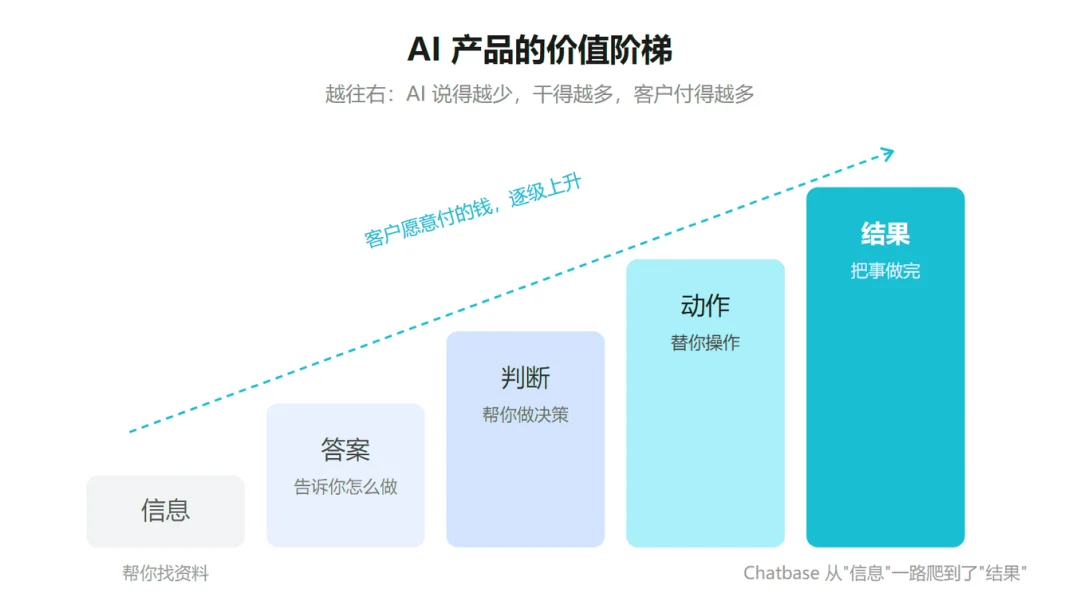
▲ The AI product value staircase
The further to the right, the less AI says, the more it accomplishes, and the more customers are willing to pay.
Anyone building AI products should ask themselves: is my AI teaching users how to do something, or already getting it done for them?
Once it started doing things, there was no going back
As soon as AI starts “doing,” it runs into a series of new problems. With each one it solves, it goes another layer deeper into a company’s business.
Changing a subscription requires knowing who you are. So a customer-identity system appeared, integrated with Stripe, CRM, and the order backend.
What if AI cannot solve the problem? It cannot just say “I can’t answer that” and leave the customer stranded. So human handoff appeared: automatically open a ticket and transfer it to a person, with the complete conversation history and customer information.
Customers do not only come through a website. They send emails, WhatsApp messages, Instagram messages, and even make phone calls. So those channels were connected one after another, eventually including voice customer service by phone.
Then came the most interesting step: in 2026, Chatbase built its own Help Desk.
Its original positioning was “add an AI layer to customer-service systems such as Zendesk.” Now it is the customer-service system: AI resolves most issues on the front line, while people move into the background to handle only what truly needs them.
It is beginning to take the product shape of a next-generation Zendesk / Intercom. That is the most interesting thing about Chatbase today.
Compress its whole product-evolution path into one diagram, and a lovely pattern appears: it did not expand horizontally; it kept going deeper into the same customer task.
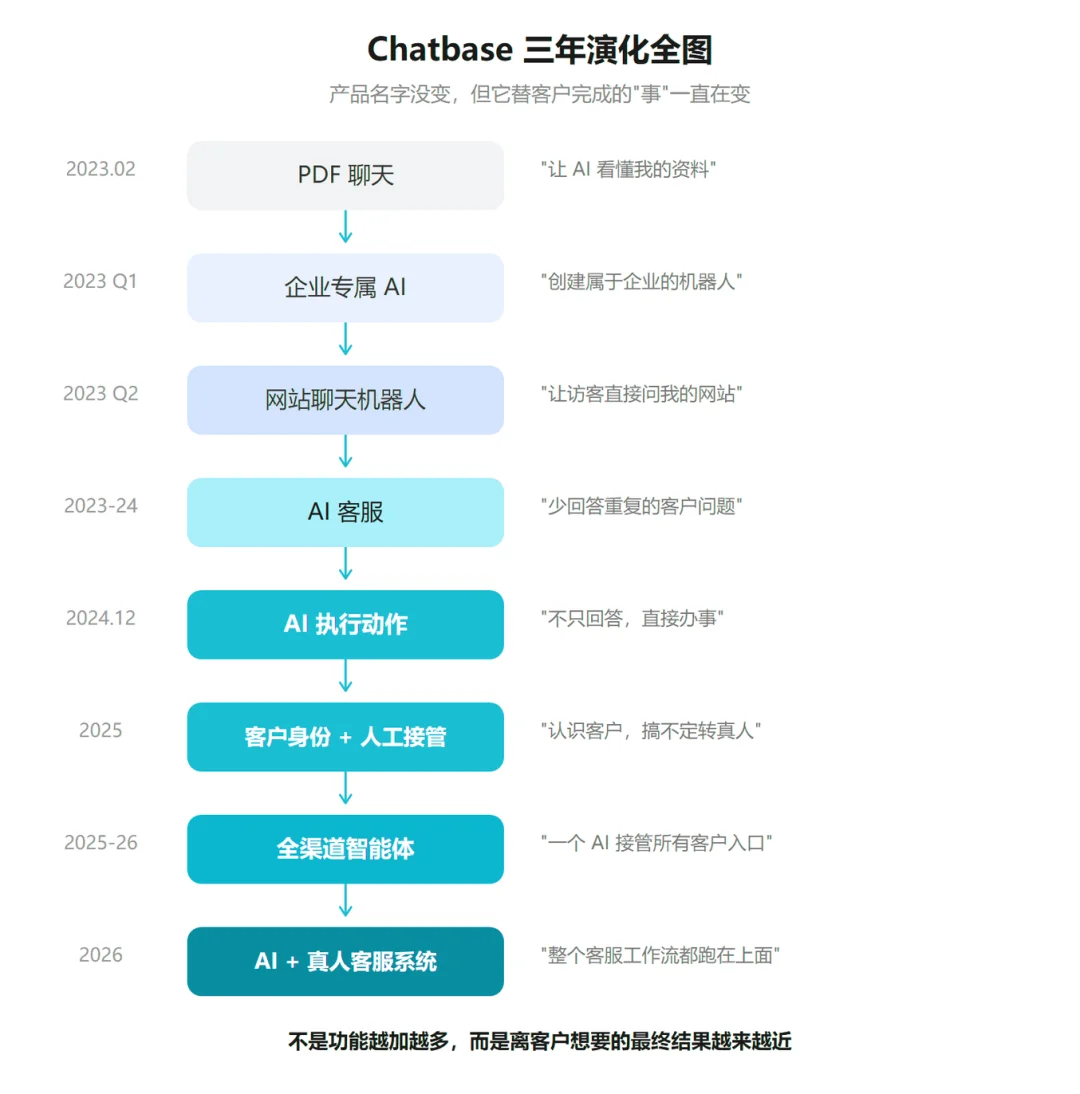
▲ Chatbase’s complete three-year evolution
Looking back today, the company seems farsighted, as if it had spent three years building to a blueprint.
But stand in 2023 and look forward: there was no blueprint, only a series of small decisions driven by users’ needs:
Someone wants AI on their website? Support embedding.
Businesses use it to answer customer-service questions? Go deeper into customer service.
Customers say answers alone are not enough? Let AI take action.
To take action, AI needs to know the customer? Build an identity system.
AI cannot solve something? Hand it over to a person.
Customers still reach out through email and phone? Keep connecting channels.
People need a support workspace too? Build the customer-service system itself.
No single step is earth-shattering. But together, they complete a journey from “little tool” to “company.”
Sometimes strategy is simply going a little further with the user at each step. Looking back and connecting those steps, you find that a path has already emerged.
I see at least three rounds of PMF—product-market fit—along this path
Finding product-market fit even once is difficult. Chatbase found it at least three times.
The first was technology-driven PMF: “AI can actually read my materials.” This was fit driven by a technical capability, with a powerful time window but an extremely weak moat.
The second was scenario-driven PMF: businesses paid real money to “hire fewer support staff and answer customers instantly.” This fit was driven by a specific use case, with a much bigger market and much more enduring demand.
The third was process-driven PMF: when orders, payments, tickets, and human customer service all run on Chatbase, it has moved from a “feature” into enterprise processes. Once a workflow is embedded in it, real product stickiness starts to appear.
This is also why its revenue curve can keep rising.
Its early growth was remarkable: more than $1,000 in MRR—monthly recurring revenue—in its first week, and $1 million in ARR in just 117 days. But it did not stop at that first wave of AI opportunity.
The first $1 million came from the explosive potential of AI’s window of opportunity. Going from $1 million to $10 million was different: $1 million to $3 million took seven months, and $3 million to $5 million took a full year. That depended on the real work of going deeper into customers’ business processes, inch by inch.
A wave of opportunity can only take you to the starting line. After that, you have to work your way into the customer’s business, inch by inch.
What stayed with me most was a question it kept asking
Everything above is still on the surface. After thinking about this case repeatedly, I realized that Chatbase’s most precious quality was not any one pivot, but a recurring action:
The founder kept asking himself: users say they want this feature, but what are they really trying to accomplish?
A user says they want to “chat with a PDF.” What lies underneath: let AI understand my materials.
A business says it wants a “website bot.” What lies underneath: answer fewer repetitive questions.
A business says it wants AI to “answer customers.” What it truly wants: resolve the customer’s issue directly.
Each time, he did not stop at what users said aloud. He dug one layer deeper, then took another step towards that deeper “result.”
Features are only what appears on the surface. Results are the real need.
I think everyone who builds products should stick that sentence beside their computer.
So what can we learn from it?
Pulling these scattered impressions together, I see roughly four lessons.
First, its greatest strength was not finding a good idea, but continually overturning a product definition that had already succeeded.
When most founders find a product that starts making money, their instinct is: “We’ve finally found our direction. Now just make it good.”
Chatbase did not.
Every time it earned another wave of revenue, he asked three questions: why do users use me? What are they really trying to accomplish? Am I delivering the final value, or just one small step towards it?
While making money from PDF Chat, Chatbase did not say, “I am the best PDF chat tool.” While making money from website bots, it did not say, “I am the best Chatbot Builder.” He kept overturning a product definition that was already working, moving another step towards the result users really wanted.
Its evolution was essentially a continual move from the “features” users said they wanted towards the “results” they truly wanted.
I think this lesson is particularly relevant to founders.
Second, do not worry about your moat too early. Get users first.
Founders today easily fall into a particular anxiety: isn’t this just a ChatGPT wrapper? There are no barriers to entry.
Chatbase is an excellent counterexample, but it does not prove that wrappers have a moat. It proves that a wrapper can be a good starting point, but cannot be the destination.
In 2023, Chatbase was a standard wrapper. The model was not its own, nor was the database; its foundations depended entirely on others. If it had never started because it “had no moat,” not a penny of the subsequent $10 million would exist.
Its later path was: AI capability → real use case → business process → system integration → core enterprise software. An “AI wrapper” anyone could copy gradually became a working system a company could not move away from.
Your moat does not have to be designed on day one. It can grow, layer by layer, along real users’ needs.
Do not let the inability to “see a moat” stop you from beginning. I hope this helps some AI Builders who “think too much.”
Third, it shows a rhythm of entrepreneurship distinctive to the AI era.
Not the traditional sequence: “research the market for six months → plan → raise funding → assemble a team → develop for a year → launch.”
Instead: “a new capability appears → make an MVP in a few days → launch → collect payment → redefine the product around real needs.”
Looking back, Chatbase’s path seems as complete as a carefully planned strategy. But from the vantage point of 2023, it was simply a series of very reasonable small decisions pushed forward by users.
You do not necessarily need to know what the company will be in five years. You only need to know the next step users most want you to take now.
Fourth, consumer or business? Do not rush to label it. Follow the value.
As an aside, this case also resolved a question I had struggled with for a long time: should I build for consumers or for businesses?
At first, Chatbase looked every bit like a small consumer tool. Users pushed it into the enterprise market. That affected me personally quite a lot.
So there really is no need to rush into labels early on. Better questions are: who needs me most? Who gets the greatest value from me? Who is most willing to pay for that value? Who keeps asking me to “go one step further”? Follow the value, and sometimes the market will answer the question of direction for you.
Sometimes the market you start in is not the market you end up in.
By the time I reached the end of this article, I felt that what we should remember most about Chatbase was never the number “$10 million in three years.”
It was this: it never treated “the product we are building today” as its final answer.
It did not see the destination at the outset. But at every step, it moved a little closer to the result users truly wanted.
Perhaps entrepreneurship is like this—
You do not need to know where the destination is from the beginning.
But you do need to keep knowing where users really want to go.